


Introducing Legal Coaching: A Framework for Legally Intelligent Decision-Making in Risk-Sensitive Organisations

Abstract
Over the past two decades, coaching research has largely focused on leadership development and managerial performance. However, the integration of legal dimensions into coaching practice remains largely unexplored. This paper introduces the concept of ‘Legal Coaching’ as a novel interdisciplinary approach at the intersection of coaching psychology, preventive law, and corporate governance.
This paper presents a conceptual framework and does not report empirical findings; the vignettes included are practice-informed illustrations designed to demonstrate the applicability of the framework, not to validate it empirically. Drawing on abductive reasoning and cross-disciplinary synthesis, it establishes a foundational Legal Coaching Framework (LCF) and introduces the L-COACH operational model, designed to develop managers’ legal risk literacy and support informed decision-making. The model is intended to help managers (a) identify early warning signals of legal risk, (b) interpret these cues within complex organisational contexts , and ( c ) determine the appropriate timing for escalation to legal specialists, consistent with principles of internalised legal reasoning.
By engaging with legal awareness and metacognitive processes, this paper argues that Legal Coaching represents a relevant intervention for supporting proactive legal risk management and responsible governance in risk-sensitive organisations. This work contributes to an emerging area of inquiry by connecting coaching literature with legal risk management and proposing a research agenda for future empirical investigation.
Keywords: Legal Coaching, L-COACH, Legal Awareness, Preventive Law, Coaching Psychology, Organisational Sensemaking, Behavioural Governance, Managerial Decision Making
Introduction Coaching has emerged as a sophisticated intervention within organisational development, widely employed to enhance leadership and managerial performance (Passmore, 2021). Existing literature underscores that coaching facilitates professional growth by Introducing Legal Coaching: A Framework for Legally Intelligent Decision-Making in Risk-Sensitive Organisations strengthening self-efficacy and developing the capacity for reflective inquiry (Grant, 2012; Ely et al., 2010). Through the interrogation of underlying assumptions and the experimentation with new behavioural patterns, coaching enables individuals to navigate complex professional challenges with heightened cognitive clarity (Grant, 2012). Despite these advancements, the intersection of coaching and legal risk management remains largely unexplored. While coaching research has predominantly centred on performance outcomes, its potential role in developing managerial legal sensitivity—the cognitive capacity to perceive legal implications within everyday decision-making—has received limited scholarly attention. This is consequential, as managers in complex environments frequently operate under conditions of high uncertainty and time pressure, where routine decisions may carry substantial legal implications that are not immediately visible. Processes such as resolving employee grievances or negotiating commercial partnerships, for instance, may involve latent legal risks that are not immediately visible. Traditional risk management approaches tend to remain reactive, engaging formal legal counsel only after conflicts have crystallised. This reactive reliance creates a structural vulnerability: managers may lack the cognitive frameworks required to detect early signals of legal risk during the decision-making process (Weick, 1995). This paper introduces ‘Legal Coaching’ as a conceptual response to this gap. Unlike traditional compliance training, which focuses on rule-memorisation, legal coaching is proposed as a metacognitive approach that may encourage managers to pause, reframe assumptions, and determine when specialised legal escalation is appropriate (Coppola, 2020). This paper adopts a conceptual-analytical design, drawing on interdisciplinary literature synthesis and theoretical framework construction. The vignettes included in Section 9 are practice-informed illustrations intended to demonstrate the framework’s applicability, not to validate it empirically. To this end, the paper introduces two connected contributions: the Legal Coaching Framework (LCF), which provides the conceptual structure, and the L-COACH operational model, which translates that structure into a practical, stepwise process. Together, these contributions aim to establish a theoretical connection between coaching psychology and preventive law, and to propose a basis for future empirical investigation into legally intelligent managerial decision-making. 2. The Emergence and Logic of Legal Coaching The concept of “legal coaching” can be understood at the intersection of three significant streams in contemporary scholarly literature: preventive law, coaching psychology, and research on managerial cognition and reflective decision-making. While each of these fields addresses risk management in professional settings from a distinct vantage point, Introducing Legal Coaching: A Framework for Legally Intelligent Decision-Making in Risk-Sensitive Organisations their synthesis offers a theoretical perspective for understanding and managing legal risks within organisations. First, the preventive law approach, with roots tracing back to the work of Louis Brown (Brown & Dauer, 1994), is founded on the premise that many legal disputes and litigations are preventable if organisations can identify early cues of legal risk before they escalate into crises. From this perspective, focusing solely on dispute resolution after the fact is insufficient. Instead, organisations require mechanisms that enable decision-makers to identify the potential legal implications of their choices at the early stages, thereby averting costly conflicts. However, preventive law scholarship has largely focused on structural and procedural mechanisms, with limited attention to the cognitive and behavioural dimensions of how individual managers detect and respond to legal risk signals. Complementing this approach, the literature on coaching psychology has demonstrated that coaching processes—through reflective inquiry, the development of self-awareness, and the re-examination of mental models—can enhance an individual’s capacity to navigate complex situations and make more informed decisions. Scholars in this field, such as Grant (Grant, 2012) and Passmore (Passmore, 2021), have highlighted that coaching serves not merely as a performance improvement tool, but as a mechanism to facilitate reflective learning and the critical review of mental assumptions—a process that enables managers to evaluate the potential consequences of their decisions with greater precision. Nevertheless, existing coaching frameworks have not systematically addressed legal risk contexts, leaving a gap that this paper seeks to fill. The third theoretical stream that informs this issue is the literature on professional reflection and managerial cognition. Donald Schön’s work on “reflective practice” (Schön, 1983) suggests that many professional decisions are made in situations characterised by uncertainty, complexity, and contextual judgement. In such conditions, an individual’s ability to pause, re-evaluate underlying assumptions, and attend to the hidden implications of their decisions plays a crucial role in the quality of their decision-making. Yet this body of literature has rarely been applied to the specific domain of legal risk awareness in organisational settings, representing a further theoretical gap. The convergence of these three theoretical streams provides the foundation for the concept of “legal coaching.” Within this framework, legal coaching is an endeavour to apply the mechanisms of reflective learning in coaching to enhance legal awareness in managerial decision-making processes. The objective of this approach is to enable managers to detect early cues of legal risk in organisational interactions and decisions, reflect on the potential implications of their actions, and, when necessary, seek specialised legal advice at the appropriate time. From this perspective, legal coaching is not a substitute for legal expertise or professional counsel; rather, it serves as a cognitive and behavioural complement for the effective utilisation of legal knowledge. This approach focuses on the stage preceding the entry of a Introducing Legal Coaching: A Framework for Legally Intelligent Decision-Making in Risk-Sensitive Organisations problem into formal legal processes—a stage where enhanced situational awareness, managerial reflection, and the timely detection of sensitive situations can prevent the formation of many legal risks. Based on this rationale, this paper introduces the “Legal Coaching Framework (LCF)” to demonstrate how coaching processes can foster managerial legal awareness and strengthen proactive legal risk management in organisations. Based on the theoretical synthesis presented above, we advance the following propositions to guide future empirical investigation: P1: Managers who engage in structured legal coaching interventions will demonstrate higher levels of legal risk literacy and earlier detection of legal cues compared to those relying solely on formal legal consultation. P2: Reflective coaching processes that target the re-examination of managerial mental models will enhance metacognitive awareness of legal risk signals, thereby reducing unnecessary or premature escalation while supporting timely and informed referral to legal specialists where appropriate. 3. Methodology This study adopts a conceptual-analytical research design, combining interdisciplinary literature synthesis with theoretical framework construction (Jaakkola, 2020; Passmore, 2021). Conceptual-analytical methodology is appropriate when the primary aim is to develop theoretical constructs that integrate existing knowledge streams into a coherent explanatory architecture — particularly in nascent fields where empirical investigation presupposes conceptual clarity (Gilson & Goldberg, 2015; Schön, 1983). Legal coaching, as a distinct domain of inquiry, currently lacks an established theoretical foundation; accordingly, this study prioritises conceptual development as a necessary precondition for future empirical work. 3.1 Literature Synthesis A structured review of scholarly literature was conducted across three intersecting domains: (i) preventive law and proactive legal risk management; (ii) coaching psychology and reflective practice; and (iii) managerial cognition and organisational decision-making under uncertainty. Source selection followed three explicit criteria. First, theoretical relevance: sources were included if they directly addressed the cognitive, behavioural, or institutional dimensions of legal risk literacy in organisational settings. Second, disciplinary breadth: given the interdisciplinary nature of the inquiry, sources were drawn from legal Introducing Legal Coaching: A Framework for Legally Intelligent Decision-Making in Risk-Sensitive Organisations scholarship, organisational psychology, and management science to avoid singlediscipline bias. Third, conceptual utility: priority was given to works that offered transferable constructs — such as reflective practice (Schön, 1983), bounded rationality (Simon, 1955), and proactive legal risk management (Dauer, 2004) — capable of informing a practitioner-oriented framework. 3.2 Framework Construction The Legal Coaching Framework (LCF) was constructed through an abductive reasoning process (Timmermans & Tavory, 2012), moving iteratively between the synthesised literature and an emerging conceptual architecture. This involved three analytical steps: 1. Identifying convergence points across the three literature streams — specifically, the shared emphasis on anticipatory cognition, reflective decision-making, and structured escalation as responses to legal uncertainty. 2. Mapping competency boundaries — distinguishing the cognitive and behavioural competencies required for legally intelligent decision-making from those addressed by conventional compliance training or direct legal advice. 3. Defining structural relationships — establishing how the framework’s components relate to one another logically and sequentially, such that each stage presupposes and builds upon the preceding one. 3.3 Operational Model Formulation The LCF was subsequently translated into the L-COACH operational model — a practitioner-oriented tool designed to guide managers through structured legal risk detection and escalation processes (McKergow & Jackson, 2011; Higgins, 2000). Each component of the model was derived deductively from the framework’s theoretical premises, with internal consistency assessed against three criteria: (a) logical coherence between sequential stages; (b) non-redundancy of component functions; and © alignment with the competency boundaries established in Section 3.2. This approach to internal validation is consistent with established practice in conceptual model development (Whetten, 1989; Weick, 1989). 3.4 Scope and Limitations This study is primarily theoretical in scope. Analytical case illustrations employed in subsequent sections serve as conceptual demonstrations of the framework’s
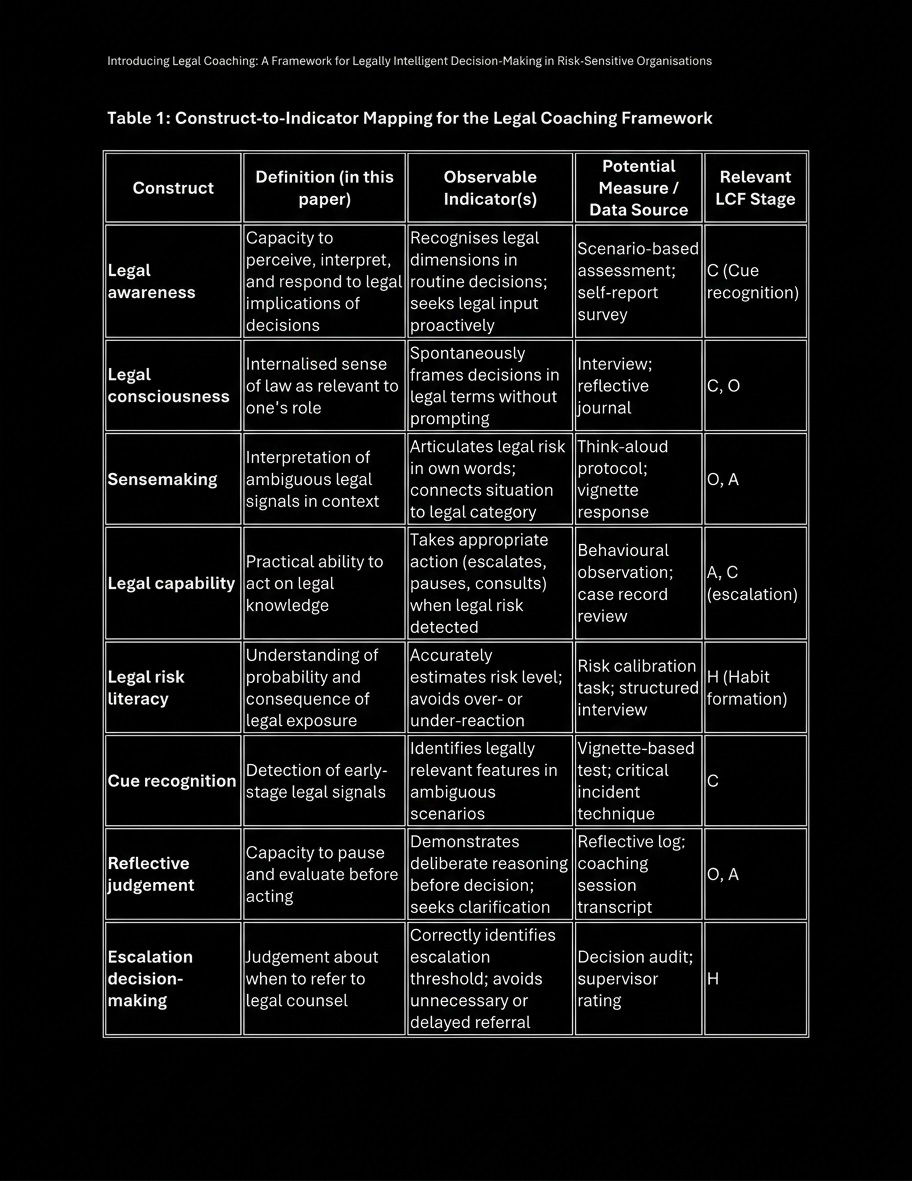
Introducing Legal Coaching: A Framework for Legally Intelligent Decision-Making in Risk-Sensitive Organisations applicability; they do not constitute empirical findings and should not be interpreted as validation evidence. The distinction between illustration and validation is maintained throughout: illustrations show that the framework is applicable, not that it is confirmed. Empirical validation — through qualitative fieldwork, organisational pilots, or mixedmethods research in risk-sensitive industries — remains an explicit priority for future research (Reason, 2000; Weick, Sutcliffe & Obstfeld, 2005). 4. The Theoretical Positioning of Legal Awareness To establish a robust theoretical foundation for legal coaching, it is necessary to position legal awareness in relation to established constructs in socio-legal studies and organisational theory. In this article, legal awareness is understood as the capacity through which managers perceive, interpret, and respond to the legal implications of their professional decisions. It therefore extends beyond formal legal knowledge and encompasses the practical meaning-making process through which legal considerations are recognised and translated into action (Suchman & Edelman, 1997). Within this broader conceptual terrain, several adjacent constructs provide important theoretical anchors. Legal consciousness refers to the ways in which individuals experience, understand, and act in relation to law in everyday life (Ewick & Silbey, 1998; Cowan, 2004). From an organisational perspective, sensemaking explains how actors interpret ambiguous or uncertain situations and convert them into plausible courses of action (Weick, 1995; Maitlis & Christianson, 2014). In this sense, managers do not merely apply legal rules mechanically; rather, they actively construct interpretations of potentially risky situations as they unfold (Weick et al., 2005). By contrast, legal capability may be understood as a practical capacity to recognise legal issues, evaluate options, and mobilise appropriate responses (Jones et al., 2016; ). Similarly, legal risk literacy can be conceptualised as the ability to identify and assess the legal consequences of decisions under conditions of uncertainty. While these constructs remain emergent in the literature, they usefully capture the specific managerial competencies that legal coaching seeks to develop (Passmore & Fillery-Travis, 2011). Accordingly, legal coaching is positioned at the intersection of legal consciousness, organisational sensemaking, and managerial legal capability. It is not intended to transform managers into legal experts or replace formal legal counsel (Coppola, 2020). Rather, its purpose is to heighten situational awareness, sharpen sensitivity to early legal cues, and cultivate reflective judgement in grey-area organisational contexts. Through this enhanced capacity, legal coaching equips managers to detect potential legal risks at an early stage and seek specialised legal advice at the appropriate moment, thereby contributing to conflict prevention, enhanced regulatory compliance, and more responsible governance (Tyler, 2006; Parker & Nielsen, 2011). Introducing Legal Coaching: A Framework for Legally Intelligent Decision-Making in Risk-Sensitive Organisations Table 1: Construct-to-Indicator Mapping for the Legal Coaching Framework.
Introducing Legal Coaching: A Framework for Legally Intelligent Decision-Making in Risk-Sensitive Organisations
Note on LCF Stages: C = Cue recognition; O = Orientation; A = Action; H = Habit formation (aligned with L-COACH model stages).
Footnote:
This table maps theoretical constructs to candidate indicators for the purpose of guiding future empirical research. No measurement instruments have been validated in this study. The indicators listed are illustrative and intended to support operationalisation in subsequent quantitative or mixed-methods investigations.
- DistinguishingLegal Coaching from Legal Advice
Legal coaching and legal advice both operate within the legal periphery of organisational life; however, they remain conceptually and professionally distinct in terms of their nature of intervention, primary objectives, scope of liability, and professional foundations. A rigorous delineation of these boundaries is necessary to prevent role confusion, uphold professional ethics, and preserve the integrity of coaching as an autonomous discipline
(Parker & Nielsen, 2011).
Legal coaching is fundamentally developmental in orientation. It focuses on strengthening managers’ legal awareness, sharpening sensitivity toward early indicators of legal risk, and fostering reflective judgement within ambiguous organisational settings (Jones et al., 2016; Passmore & Fillery-Travis, 2011). Through the application of reflective inquiry, mirroring, and cognitive reframing, the legal coach facilitates the coachee’s capacity to critically analyse the potential ramifications of their decisions and expand their legal capability (Schön, 1983). In this context, the coach functions as a facilitator of cognitive and reflective processes — not as a source of legal counsel.
Legal advice, by contrast, is specialised and normative. The legal advisor draws on formal statutes and regulations to provide technical analysis, interpret legal provisions, and deliver specific professional solutions. Such interventions — including drafting contracts, preparing legal filings, or formulating litigation strategies — require formal professional credentials, expertise in relevant legislation, and the assumption of strict professional liability for the accuracy and legality of the advice rendered (Edelman & Suchman, 1997; Parker, 2002).
The divergence between these two forms of intervention is most apparent in their respective outcomes. Legal coaching culminates in enhanced reflective capacity, heightened situational awareness, and improved managerial judgement. Legal advice culminates in actionable directives grounded in statutory interpretation. In essence, legal
Introducing Legal Coaching: A Framework for Legally Intelligent Decision-Making in Risk-Sensitive Organisations
coaching centres on the process of managerial learning, while legal advice centres on the substance of legal resolution (Schön, 1983; Edelman, 2016).
It must therefore be clearly stated that legal coaching does not constitute the practice of law. It is not a surrogate for legal counsel, nor does it involve authoritative legal interpretation. Its core function is to facilitate reflection and to equip managers with the capacity to discern when formal legal intervention becomes necessary. Accordingly, whenever a scenario requires technical legal analysis or statutory interpretation, referral to qualified legal counsel is a professional and ethical obligation — one that preserves the integrity of legal coaching while strictly respecting the protected domain of the legal profession (Parker & Nielsen, 2011).
Table 2: Distinguishing Legal Coaching from Legal Advice
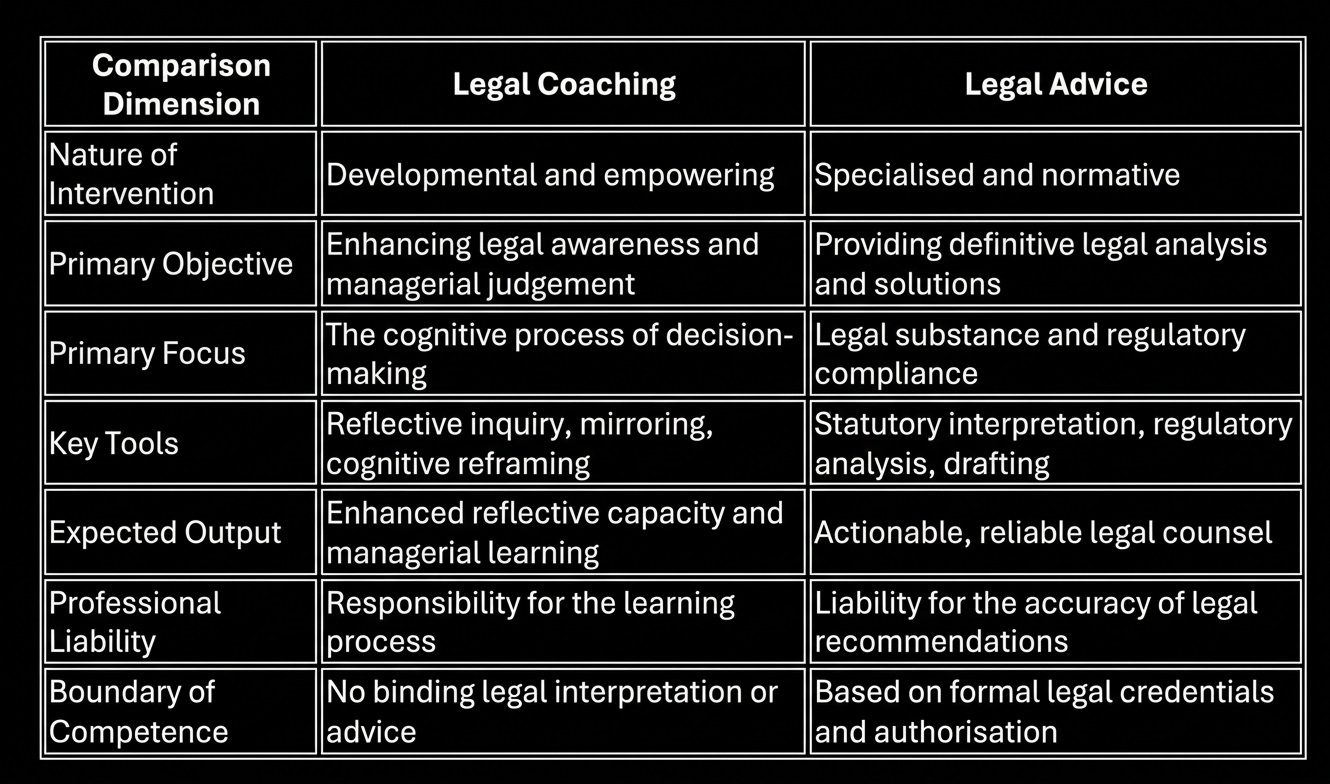
Sources: Schön (1983); Edelman & Suchman (1997); Parker & Nielsen (2011); Jones et al. (2016).
6. The Legal Coaching Framework (LCF)
The Legal Coaching Framework (LCF) is a conceptual model describing the cognitive process through which managers may develop legal awareness in the context of organisational decision-making. The framework rests on the premise that legal risks rarely emerge at the moment of crisis; rather, they tend to form at earlier stages of organisational
Introducing Legal Coaching: A Framework for Legally Intelligent Decision-Making in Risk-Sensitive Organisations
interaction, when initial signals remain ambiguous, dispersed, or seemingly inconsequential (Reason, 1997; Weick & Sutcliffe, 2007). Under such conditions, the quality of managerial judgement depends substantially on the capacity to recognise, interpret, and evaluate these early cues.
The LCF conceptualises this process as three interrelated stages, beginning with the recognition of early cues and culminating in an informed decision regarding whether to act independently or to refer the matter to legal specialists. This sequence aligns with the Recognition-Primed Decision (RPD) model, which holds that experienced decision-makers often act by matching current situations to previously internalised patterns. Through the LCF, managers may be supported in moving from intuitive, and potentially unreliable, assessments toward a more structured form of legal reasoning, thereby facilitating the earlier identification of potential liabilities before they develop into systemic organisational failures (Sitkin & Pablo, 1992; Reason, 2000).
6.1 Cue Recognition
In many organisational contexts, legal risks do not present themselves as explicit or clearly defined problems. Instead, they surface as subtle cues or “weak signals” embedded within routine interactions (Ansoff, 1975). Such cues may manifest as conflicts of interest, ambiguities in formal communication, the use of imprecise legal language in correspondence, or inconsistencies in contractual terms. At this stage, the coaching process is directed toward developing the manager’s sensitivity to these early indicators (Weick & Sutcliffe, 2007; Endsley, 1995).
Through reflective questioning and structured feedback, the legal coach supports the manager in observing the situation more carefully and identifying elements that may carry legal significance (Schön, 1983; Passmore & Fillery-Travis, 2011). The primary outcome of this stage is an enhanced situational awareness of the potential presence of legal risk within organisational interactions (Flin, O’Connor & Crichton, 2008). It should be noted, however, that cue recognition is inherently subject to individual cognitive limitations; not all legally significant signals will be detected, and the reliability of this stage depends substantially on the manager’s prior experience and the quality of the coaching dialogue.
6.2 Reflective Interpretation
Once relevant cues have been identified, the second stage focuses on their reflective interpretation and the construction of meaning from the situation. At this point, the manager — supported by the coach — steps back from immediate, intuitive reactions and examines the situation from multiple perspectives (Schön, 1983; Weick, 1995). This process may involve attending simultaneously to the legal, ethical, organisational, and relational dimensions of a decision (Brown & Treviño, 2006).
Introducing Legal Coaching: A Framework for Legally Intelligent Decision-Making in Risk-Sensitive Organisations
The coaching dialogue in this phase supports the manager in differentiating between personal interpretation, legal requirement, and organisational consideration, thereby enabling the construction of a more accurate picture of the potential consequences of available choices (Maitlis & Christianson, 2014). Such reflective interpretation provides the foundation for more deliberate and well-reasoned judgement in complex decision-making contexts (Kahneman, 2011). Nevertheless, the effectiveness of this interpretive process remains contingent on the manager’s willingness to engage in genuine reflection, and on the coach’s capacity to facilitate productive sensemaking rather than merely confirming existing assumptions.
6.3 Escalation Decision-Making
The third stage centres on the point at which the manager must determine how to proceed. In some instances, the matter may be manageable at the managerial level; in others, continuing without the involvement of a legal specialist may generate substantial organisational risk (Sitkin & Pablo, 1992; Reason, 1997).
At this stage, the coach supports the manager in realistically appraising the situation and recognising potential cognitive biases — including overconfidence, excessive simplification, or reluctance to refer the matter onward (Kahneman, 2011; Bazerman & Moore, 2013). The aim is to strengthen the manager’s capacity to identify an appropriate point at which legal expertise becomes necessary, and to make a considered choice between independent action and referral to a qualified legal advisor (Parker & Nielsen, 2011; Jones et al., 2016). The quality of this escalation decision is likely to vary across individuals and organisational contexts, and the framework does not presuppose a universally optimal threshold for referral.
6.4 Internalised Legal Reasoning
A central construct underlying the LCF is what may be termed internalised legal reasoning — defined here as a set of mental schemas and interpretive patterns that individuals develop through repeated experience, structured reflection, and coaching-supported learning. As a theoretical construct, internalised legal reasoning refers to the gradual integration of legal sensitivity into managerial cognition, such that awareness of potential legal consequences becomes an embedded feature of routine decision-making rather than an externally imposed consideration (Schön, 1983). This construct is analytically distinct from formal legal knowledge: it does not require the manager to possess expertise in law, but rather to develop a calibrated sensitivity to legally significant situations that warrants further inquiry or specialist involvement.
The development of internalised legal reasoning is not a discrete outcome but an ongoing process. As managers engage repeatedly with the three stages of the LCF, their capacity to detect legally significant cues, interpret ambiguous situations, and calibrate escalation decisions may be progressively refined (Weick, 1995). This gradual accumulation of
Introducing Legal Coaching: A Framework for Legally Intelligent Decision-Making in Risk-Sensitive Organisations
structured legal experience constitutes what the framework understands as the analytical bridge between initial intuitive reaction and formal legal intervention. The extent to which this construct can be reliably developed and measured across different managerial populations remains an open empirical question, and one that future research should address.
6.5 Theoretical Propositions
Drawing on the theoretical logic of the LCF, two propositions are advanced to guide future empirical investigation:
Proposition 3 (P3): Managers who engage in structured legal coaching — encompassing cue recognition, reflective interpretation, and escalation decision-making — are more likely to identify legally significant signals at an early stage than managers who rely solely on intuitive judgement.
Proposition 4 (P4): Repeated engagement with the LCF process is associated with the progressive development of internalised legal reasoning, such that legal sensitivity becomes increasingly embedded in routine managerial decision-making over time.
These propositions are intended as theoretically grounded starting points for empirical inquiry rather than as definitive claims. Their validation would require longitudinal research designs capable of capturing changes in managerial cognition and decision-making behavior across coaching engagements.
6.6 Summary
The LCF offers a structured cognitive mechanism for developing legal awareness within managerial decision-making. By integrating cue recognition, reflective interpretation, and escalation decision-making into a coherent sequence, the framework supports managers in identifying potential legal risks at an early stage, analysing sensitive situations with greater accuracy, and seeking specialised legal counsel at an appropriate point. Over time, repeated engagement with this process may contribute to the development of internalised legal reasoning — an embedded capacity that could enable more legally informed and organisationally responsible decision-making. The framework’s practical utility, however, is ultimately contingent on empirical validation across diverse organizational settings.
7. The L-COACH Model: An Operational Framework for Legal Coaching
The L-COACH model is designed as an operational translation of the conceptual Legal Coaching Framework (LCF), aimed at bridging the gap between theoretical constructs and the practical realities of coaching sessions. While the LCF clarifies the cognitive logic
Introducing Legal Coaching: A Framework for Legally Intelligent Decision-Making in Risk-Sensitive Organisations
underlying the formation of legal awareness in managerial decision-making — through the sequential processes of Cue Recognition, Reflective Interpretation, and Escalation Readiness — the L-COACH model provides coaches with a structured set of operational steps through which this theoretical logic can be applied during a coaching dialogue (Passmore & Fillery-Travis, 2011). Table 3: Distinguishing LCF from L-COACH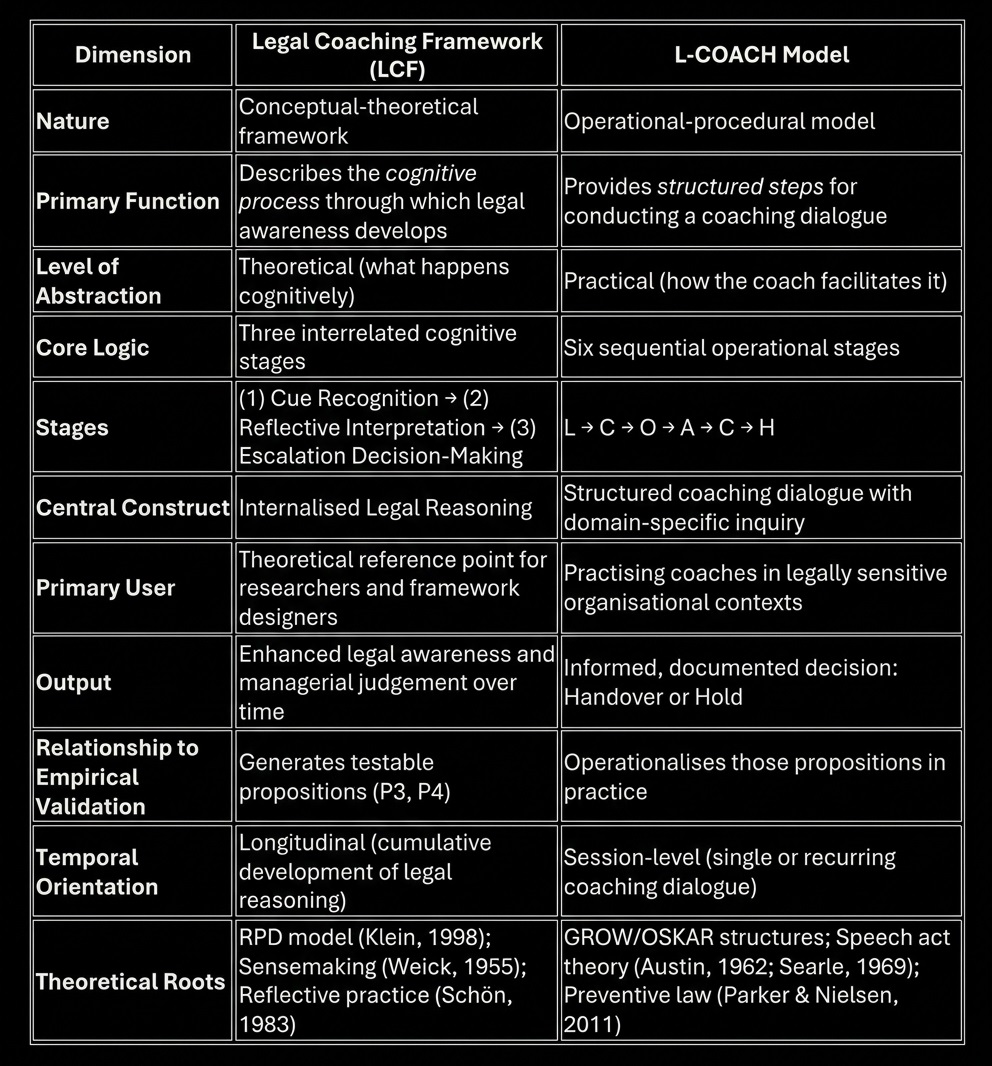
Introducing Legal Coaching: A Framework for Legally Intelligent Decision-Making in Risk-Sensitive Organisations
Note: The LCF provides the theoretical architecture; L-COACH operationalises it as a stepwise process for managerial use. The two are complementary and mutually dependent: LCF without L-COACH remains abstract; L-COACH without LCF lacks theoretical grounding.
The design of this model draws on several converging theoretical streams. Its phased structure is informed by problem-based coaching models — such as GROW (Whitmore, 2009) and OSKAR (McKergow & Jackson, 2011) — which emphasise guiding dialogues through structured inquiry. The model’s focus on reflecting upon decision-making situations resonates with the literature on reflective practice (Schön, 1983) and sensemaking approaches in managerial cognition (Maitlis & Christianson, 2014). Its specific focus on the early detection of legal risk signals aligns with preventive law and proactive legal risk management (Parker & Nielsen, 2011; Edelman & Suchman, 1997). Finally, the model’s attention to how commitments are linguistically framed draws on speech act theory (Austin, 1962; Searle, 1969). Taken together, L-COACH represents an endeavour to integrate these theoretical streams into a practical tool for coaching dialogues within the context of organisational decision-making.
Whilst L-COACH shares structural similarities with established coaching frameworks — particularly in its use of sequential, inquiry-based stages — it is distinguished by its domain-specific focus. Unlike GROW, which is designed as a general-purpose goal-setting framework, or OSKAR, which centres on solution-focused outcomes, L-COACH is specifically oriented toward situations in which managerial decisions may carry legal implications. Its stages are not merely procedural steps but correspond to distinct cognitive functions — signal detection, contextual mapping, obligation clarification, risk threshold assessment, communicative precision, and escalation decision — that are theoretically grounded in the LCF. This domain specificity represents the model’s primary point of differentiation rather than a claim of general superiority over existing frameworks.
This six-stage model is designed to be applicable in situations where managerial decisions may carry legal implications for the individual or the organisation. In this model, the coach’s inquiry transitions from a general dialogue into a purposeful process of exploring the various dimensions of risk, discretion, and legal responsibility in managerial decisions. Each stage of the model corresponds to a distinct cognitive and communicative function, collectively operationalising the LCF’s theoretical logic within the coaching interaction. The six stages — Legal Signal Detection, Context Mapping, Options and Obligations, Assessment Threshold, Commitment Framing, and Handover or Hold — are presented below.
L — Legal Signal Detection
Introducing Legal Coaching: A Framework for Legally Intelligent Decision-Making in Risk-Sensitive Organisations
In the first stage — corresponding to the LCF’s Cue Recognition process — the coach guides the manager to systematically attend to early indicators of legal risk. Many legal issues in organisations do not emerge abruptly; rather, they appear as subtle, fragmented signals (Ansoff, 1975). These may manifest as unwritten promises to suppliers, ambiguities in verbal agreements, the use of vague terminology in correspondence, or potential conflicts of interest. In this phase, the coaching dialogue helps the manager develop heightened sensitivity to such “weak signals,” which are often observable before a legal conflict fully crystallises (Weick & Sutcliffe, 2007).
C — Context Mapping
At this stage — corresponding to the LCF’s Reflective Interpretation process — the focus shifts from the initial signal to the broader organisational context of the decision. The coach directs the dialogue towards examining factors that may influence the legal nature of the situation, including the stakeholders involved, internal organisational policies and regulations, decision-making structures, and the manager’s scope of authority (Scott, 2008; Greenwood et al., 2017). The objective of this phase is to construct a comprehensive understanding of the environment in which the managerial decision is made, as many legal consequences arise not from a single isolated decision, but from the interaction of that decision with the surrounding organisational and institutional context. By mapping these institutional pressures, the manager gains insight into how organisational routines and power dynamics may shape legal exposure and constrain available courses of action.
O — Options and Obligations
At this stage, a clear distinction is established between the domain of managerial discretion and the scope of legal or regulatory obligations (Hambrick & Finkelstein, 1987; Sitkin & Bies, 1994). The coach assists the manager in identifying which options fall within the realm of managerial choice and which actions are predetermined by statutory requirements, organisational policies, or contractual commitments (Edelman & Suchman, 1997). This distinction enables the manager to more accurately discern the boundary between “decision-making discretion” and “legal obligation,” thereby reducing the risk of actions that might inadvertently create binding legal commitments or trigger non- compliance (Parker & Nielsen, 2011). By clarifying these boundaries, the coaching process supports the exercise of managerial creativity within the constraints of legal and regulatory frameworks, without overstepping into potential legal liability.
A — Assessment Threshold
Introducing Legal Coaching: A Framework for Legally Intelligent Decision-Making in Risk-Sensitive Organisations
At this stage, the level of risk, the degree of ambiguity, and the limits of managerial authority are assessed to determine whether the issue is manageable within the framework of managerial decision-making or requires specialised legal intervention (Sitkin & Pablo, 1992; Reason, 1997). Through reflective questioning, the coach assists the manager in reconsidering the complexity and potential consequences of the situation, challenging well-documented cognitive biases — including the illusion of control (Langer, 1975) and optimism bias (Weinstein, 1980) — that may distort risk perception (Kahneman & Tversky, 1979; Bazerman & Moore, 2013). A pivotal question at this stage may be formulated as: “Does this situation exceed your current level of authority or certainty?” (Endsley, 1995). By grounding this assessment in evidence-based inquiry, the coach facilitates a deliberate transition from intuitive risk-taking to informed decision-making (Kahneman, 2011).
C — Commitment Framing
Should the manager decide to proceed at the managerial level, the focus of the dialogue shifts to how commitments are articulated and framed. This stage corresponds to the LCF’s emphasis on Reflective Interpretation as a precondition for responsible action. Drawing on Austin’s (1962) and Searle’s (1969) speech act theory, the coach assists the manager in refining the “illocutionary force” of their professional communication — ensuring that promises, agreements, or potential commitments are expressed with precise, cautious, and transparent language (Searle & Vanderveken, 1985). This linguistic refinement is intended to reduce the risk of unintended legal liabilities, which may arise from informal managerial promises that could later be construed as binding obligations under the doctrine of promissory estoppel or implied contracts Eisenhardt, 1989). The goal of this stage is to establish a “communicative firewall,” maintaining a clear distinction between everyday managerial interactions and the creation of formal, legally binding obligations .
H — Handover or Hold
The final stage — corresponding to the LCF’s Escalation Readiness process — is dedicated to decisive action based on the prior assessments. At this juncture, the manager navigates a binary strategic choice (Simon, 1977). In cases of high complexity, elevated risk, or legal sensitivity, the matter is referred to competent legal counsel — a process defined here as Handover. This ensures that the organisation’s legal interests are safeguarded by professionals when the situation transcends the manager’s “zone of indifference” regarding legal liability (Barnard, 1938). Conversely, if the issue remains within the scope of managerial discretion, the manager may proceed — a process defined as Hold — provided that rigorous documentation is maintained, the scope of commitments is
Introducing Legal Coaching: A Framework for Legally Intelligent Decision-Making in Risk-Sensitive Organisations
transparently framed, and the risk of exceeding the manager’s authority is mitigated (Mintzberg, 1973; Argyres & Mayer, 2007). This stage supports the manager’s capacity to distinguish between operational necessity and legal peril (Parker, 2002; Edelman, 2005).
7.1 Comparative Positioning of L-COACH
To contextualise the L-COACH model within the broader landscape of coaching frameworks, Table 1 presents a comparative overview of its structural and functional characteristics relative to the GROW and OSKAR models.
Table 4: Comparative Overview of L-COACH, GROW, and OSKAR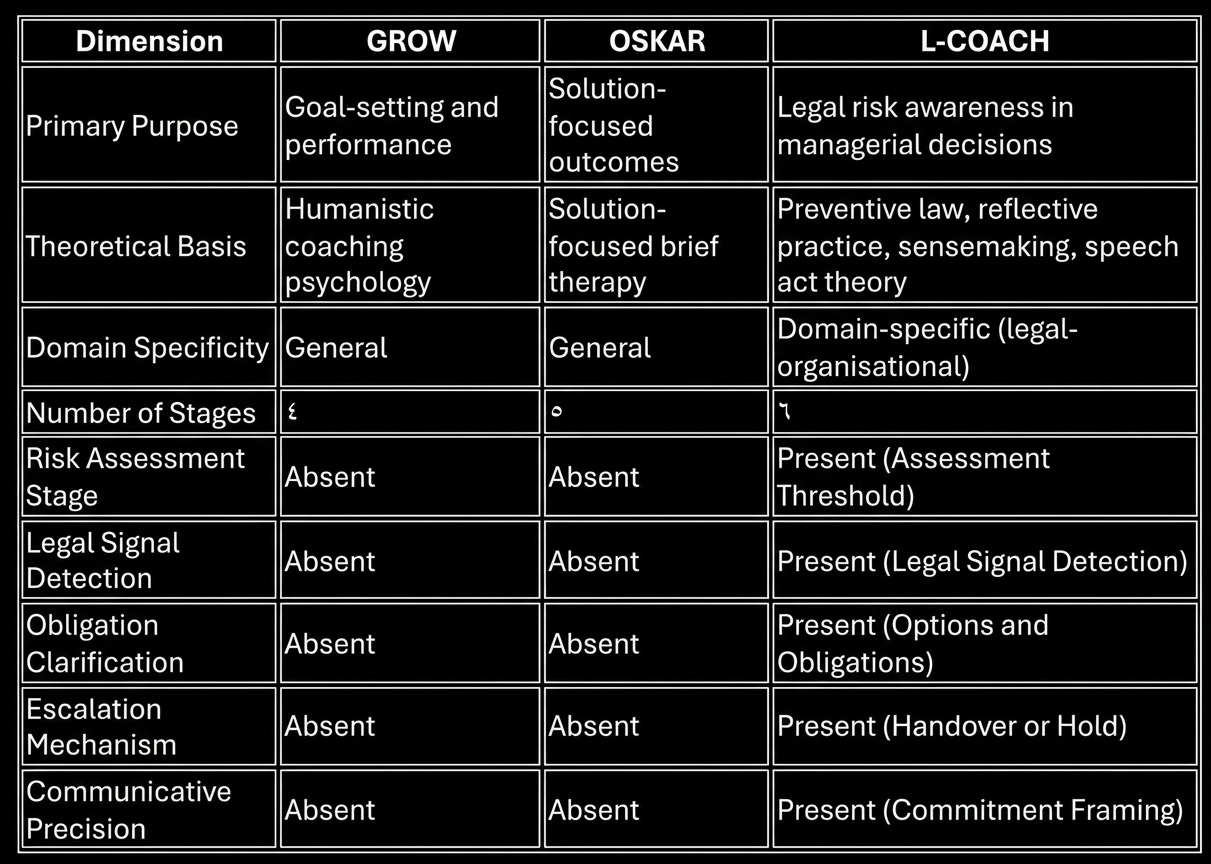
As Table 3 illustrates, L-COACH is not proposed as a replacement for general coaching frameworks but as a domain-specific complement, designed for contexts in which managerial decisions carry potential legal implications. Its distinguishing features — legal signal detection, obligation clarification, risk threshold assessment, and an explicit escalation mechanism — are absent from both GROW and OSKAR, reflecting the distinct demands of legally sensitive organisational environments.
Introducing Legal Coaching: A Framework for Legally Intelligent Decision-Making in Risk-Sensitive Organisations
7.2 Summary
In summary, the L-COACH model provides a structured mechanism for translating legal awareness from a theoretical construct into professional behaviour that is applicable in practice. By operationalising each stage of the LCF — from Cue Recognition through Reflective Interpretation to Escalation Readiness — it assists coaches in steering coaching dialogues such that managers may make more informed, reasoned, and responsible decisions in ambiguous situations with legal implications. Figure 2 illustrates the operational logic of the model, presenting L-COACH as a six-stage framework in which the coach, through structured inquiry, heightens the manager’s sensitivity to legal signals, clarifies the situational context, delineates the boundary between discretion and obligation, assesses the threshold for referral, frames commitments with precision, and ultimately supports the decision between handover and holding the matter.
8. Cognitive Mechanisms in Legal Coaching
Research in coaching psychology (Passmore & Fillery-Travis, 2011; Theeboom et al., 2014), managerial cognition (Walsh, 1995), and organisational behaviour suggests that dialogues structured around reflective inquiry can recalibrate how individuals attend to, interpret, and evaluate complex situations (Schön, 1983). In the context of legal coaching, these processes may assist managers in identifying early signals of legal risk, reflecting upon their interpretations, and evaluating potential legal implications more deliberately. These cognitive mechanisms constitute the psychological foundation of the Legal Coaching Framework (LCF) and correspond directly to the operational stages of the L-COACH model.
8.1 Metacognition
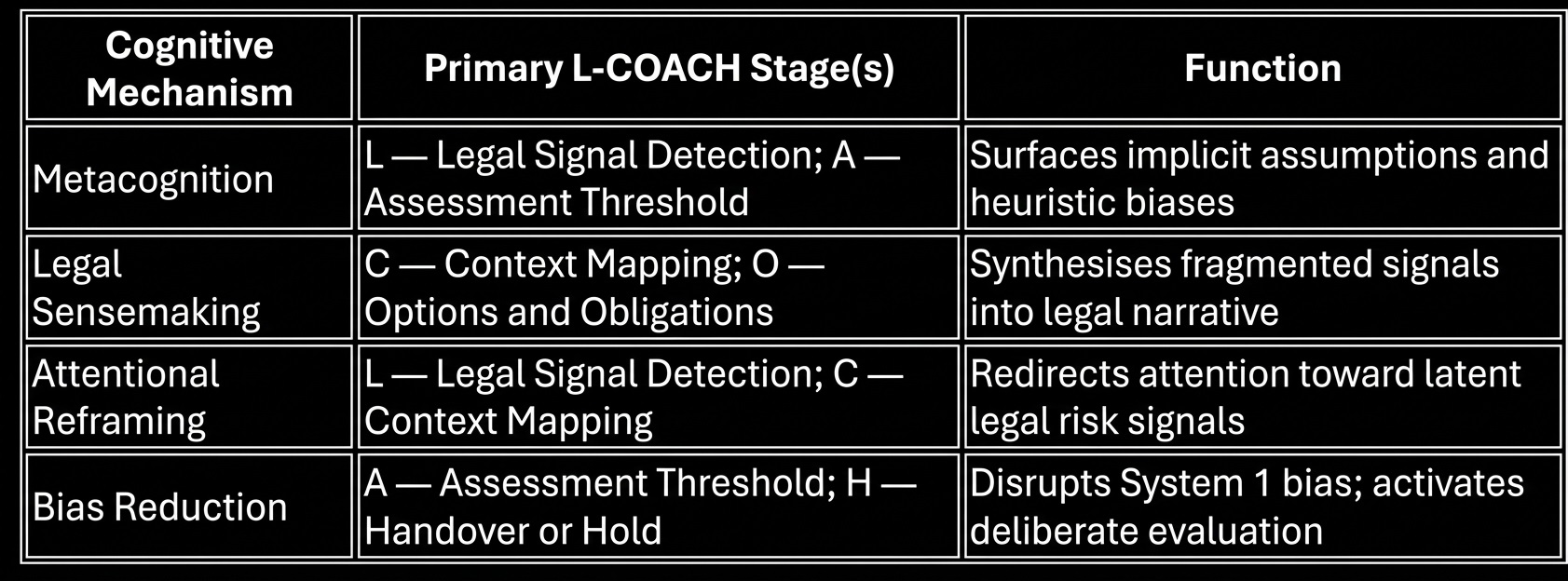
Legal coaching encourages managers to reflect upon their own thinking processes. This metacognitive awareness — defined as the ability to monitor and regulate one’s own cognitive processes (Flavell, 1979; Nelson, 1996) — enables managers to surface implicit assumptions and heuristic biases that might otherwise lead to the oversight of legal consequences (Kahneman, 2011). Within the LCF, metacognitive reflection is most directly activated during the L (Legal Signal Detection) and A (Assessment Threshold) stages of the L-COACH model, where managers are prompted to audit the logic of their situational judgements before committing to a course of action.
Proposition 5 (P5): Managers who engage in metacognitive reflection during structured legal coaching dialogues are more likely to identify and correct heuristic biases in legal risk assessment than managers who rely on unreflective intuitive judgement.
Introducing Legal Coaching: A Framework for Legally Intelligent Decision-Making in Risk-Sensitive Organisations
8.2 Legal Sensemaking
Legal dimensions of organisational decisions frequently manifest as fragmented, ambiguous signals rather than explicit warnings. Coaching dialogues may assist managers in synthesising these signals into a coherent interpretive narrative, a process grounded in sensemaking theory (Maitlis & Christianson, 2014; Weick, 1995). This enables the manager to perceive the situation not merely through a functional or operational lens, but within the broader framework of legal liability and institutional legitimacy (Ewick & Silbey, 1998; Suchman, 1995). Within the L-COACH model, this mechanism is most prominent during the C (Context Mapping) and O (Options and Obligations) stages.
8.3 Attentional Reframing
Structured inquiry shifts a manager’s attentional focus from immediate operational exigencies toward less visible legal dimensions of a situation. This cognitive mechanism — known as attentional reframing — involves the intentional alteration of the scope of situational perception (Higgins, 2000). In legal coaching, this shift is directed toward identifying subtle risk signals, such as contractual ambiguity or conflicts of interest, thereby addressing inattentional blindness in complex organisational environments (Chabris & Simons, 2010). This mechanism is operationalised most directly in the L (Legal Signal Detection) and C (Context Mapping) stages of L-COACH.
8.4 Bias Reduction in Legal Risk Assessment
Managerial decision-making is susceptible to systematic cognitive biases — including overconfidence bias (Bazerman & Moore, 2013) and optimism bias (Sharot, 2011) — that can lead to the underestimation of legal risk. By creating reflective distance between the manager and the immediate decision context, coaching may facilitate the reappraisal of entrenched judgement patterns. This process aligns with the de-biasing literature, which suggests that reflective intervention can disrupt automatic System 1 processing in favour of more deliberate System 2 evaluation (Kahneman, 2011; Stanovich & West, 2000). This mechanism is most directly engaged during the A (Assessment Threshold) and H (Handover or Hold) stages of L-COACH.
Proposition 6 (P6): Structured legal coaching, by activating System 2 deliberative processing through reflective dialogue, reduces the influence of overconfidence and optimism biases on managerial legal risk assessment.
Introducing Legal Coaching: A Framework for Legally Intelligent Decision-Making in Risk-Sensitive Organisations
8.5 Summary Mapping: Cognitive Mechanisms and L-COACH Stages
The four cognitive mechanisms examined in this section collectively explain how legal coaching reshapes managerial perception and judgement. Rather than transmitting legal knowledge directly, legal coaching operates through structured reflective dialogue to activate these mechanisms, enabling managers to recognise, interpret, and respond to legal risk signals with greater deliberateness. Table 2 maps each mechanism to its corresponding L-COACH stage, illustrating the structural coherence between the cognitive and operational dimensions of the framework.
Table 5: Cognitive Mechanisms and Corresponding L-COACH Stages
These mechanisms provide the cognitive architecture upon which the LCF and the L- COACH model are constructed. Their empirical validation remains a priority for future research.
9. Practitioner-Grounded Vignettes: Applying the Legal Coaching Framework
9.1 Overview
The following vignettes are designed to illustrate the practical applicability of the Legal Coaching Framework (LCF) and its operational model, L-COACH, across diverse organisational contexts. Rather than presenting raw interview data, this section employs a structured vignette-based approach (Hughes & Huby, 2002; Finch, 1987), in which each case is constructed from practice-informed managerial accounts and analysed through the lens of the LCF. These vignettes are illustrative in purpose; they are intended to
Introducing Legal Coaching: A Framework for Legally Intelligent Decision-Making in Risk-Sensitive Organisations
demonstrate how the framework’s concepts may manifest in practice, not to validate the framework empirically.
Each case is organised around five analytical dimensions: (1) organisational context, (2) legal signal, (3) LCF stage activated, (4) L-COACH mapping, and (5) decision outcome. Together, the four cases span the full sequence of the LCF — from initial cue recognition through to internalised legal reasoning — and illustrate how legally intelligent decision- making may manifest differently depending on sector, governance structure, and managerial disposition.
9.1.1 Methodological Note on Vignette Construction
The vignettes presented in this section are constructed using a structured vignette methodology (Hughes & Huby, 2002; Finch, 1987), in which practice-informed managerial accounts are analytically reframed through the lens of the LCF. This approach is consistent with the conceptual-analytical design of the paper: the vignettes function as illustrative instruments, not as empirical data. They are not drawn from a representative sample, nor are they intended to establish causal or statistical claims about the framework’s effectiveness.
Each vignette was constructed from practice-informed managerial accounts and subsequently mapped onto the LCF’s four stages and the six-step L-COACH model. The accounts informing these vignettes are drawn from the author’s professional practice as a legal and coaching practitioner. They are composite, anonymised, and reconstructed for analytical purposes. No primary data collection was conducted in the preparation of this paper; accordingly, no formal ethical approval was required. Where the term ‘interview- derived’ might otherwise be inferred, it is clarified that the source material reflects practice-based consultations and professional engagements rather than structured research interviews. The analytical value of this approach lies in its capacity to render abstract theoretical constructs concrete and traceable across diverse organisational contexts. Readers should interpret these cases as demonstrations of conceptual applicability rather than as evidence of empirical validation.
9.2 Case A — Risk Signal Recognition in a Media Organisation
Organisational Context
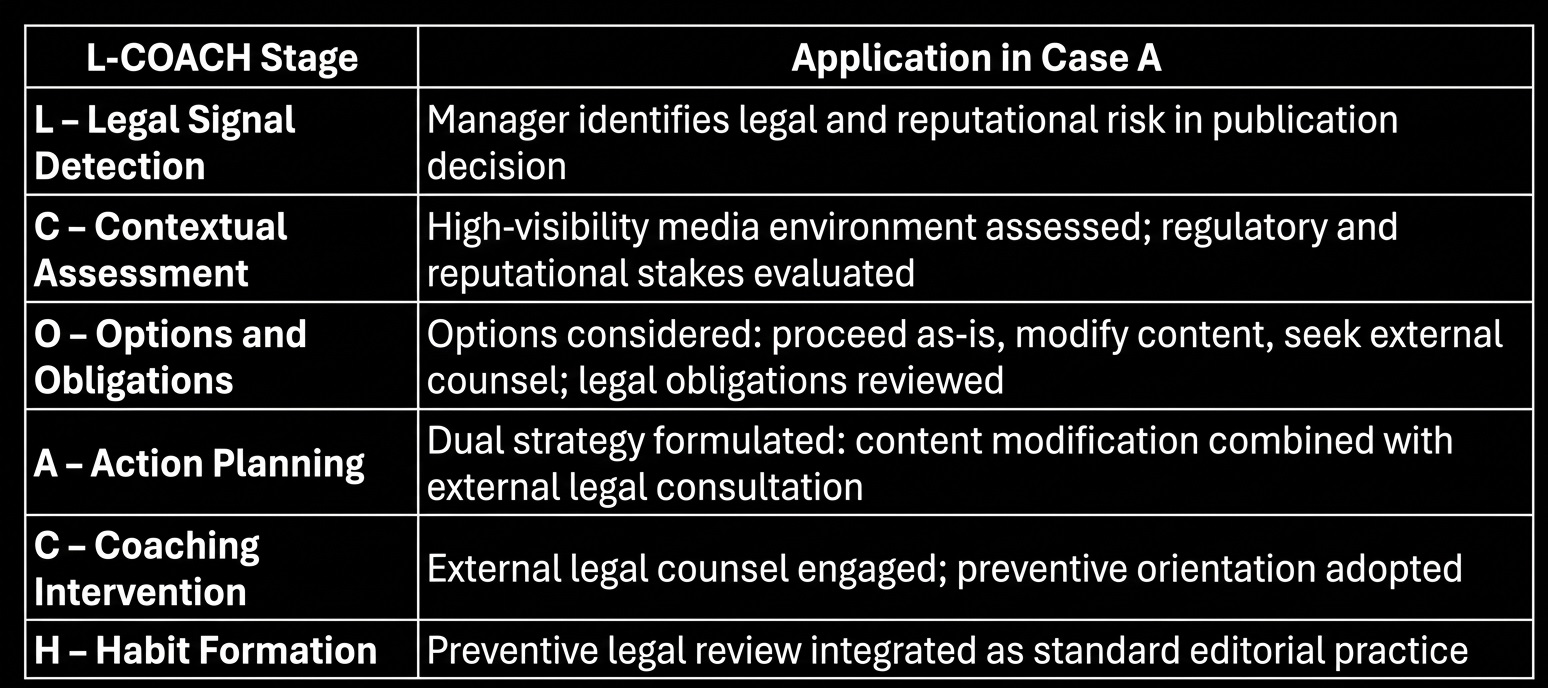
A senior manager at a media organisation encountered a situation in which editorial content under consideration for publication carried potential legal and political implications. The organisation operated in a high-visibility environment where reputational and regulatory consequences of publication decisions were significant and immediate.
Introducing Legal Coaching: A Framework for Legally Intelligent Decision-Making in Risk-Sensitive Organisations
Legal Signal
The potential for defamation liability, regulatory sanction, and reputational harm constituted the primary legal signal. The manager recognised that proceeding without legal review carried measurable institutional risk.
LCF Stage Activated
Legal Signal Detection — the manager identified a legally material cue embedded in an operational decision and responded with structured risk mitigation.
L-COACH Mapping
Decision Outcome
The manager pursued a dual strategy: content modification to reduce exposure combined with external legal consultation. This response illustrates a preventive and adaptive orientation to legal risk management — consistent with the preventive law orientation discussed in Section 5.
9.3 Case B — Reflective Interpretation Under Institutional Ambiguity
Organisational Context
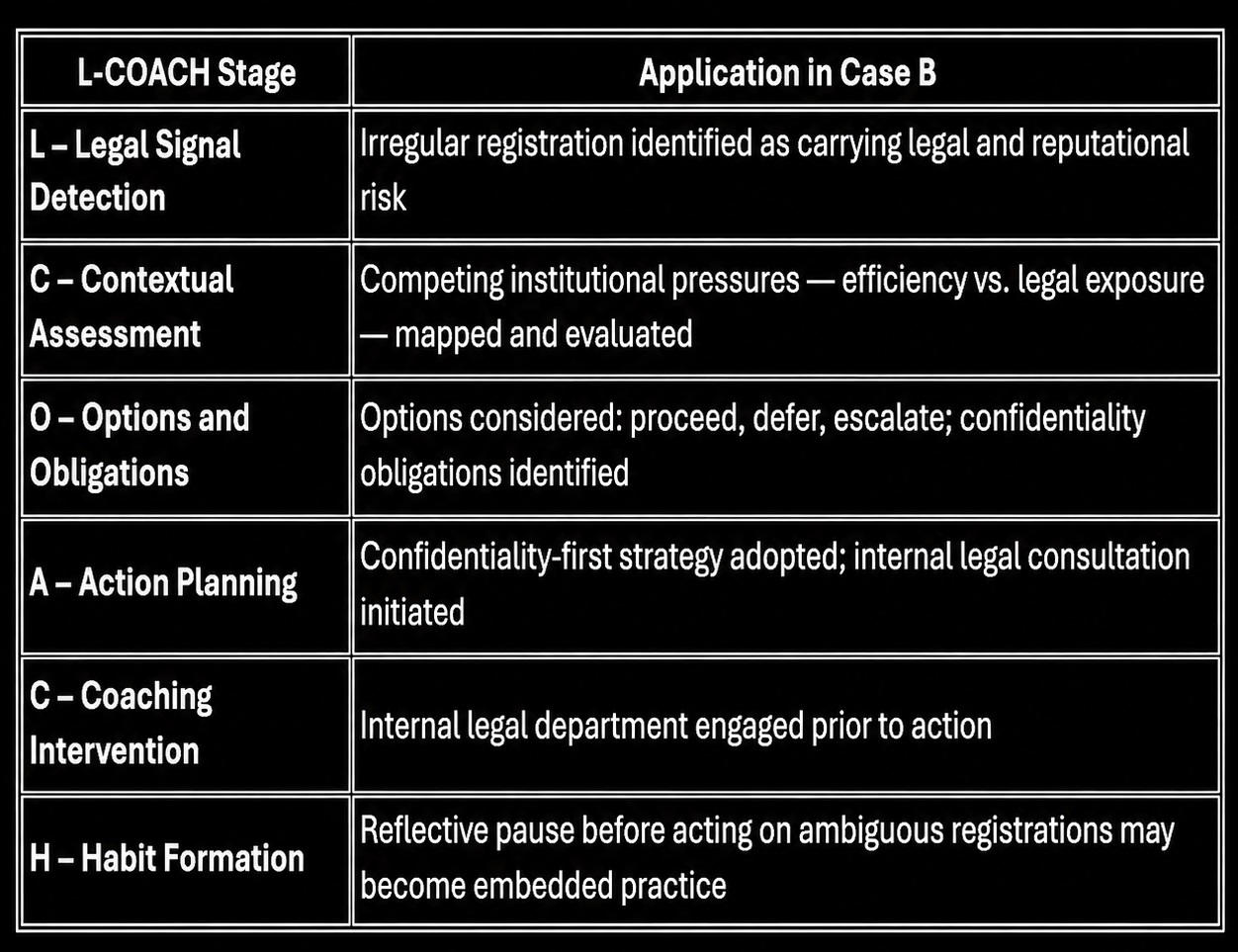
An education sector manager encountered an irregular student registration that raised concerns about the legitimacy of the applicant’s credentials and the potential institutional liability associated with proceeding. The organisation faced competing pressures: administrative efficiency on one hand, and legal and reputational exposure on the other.
Introducing Legal Coaching: A Framework for Legally Intelligent Decision-Making in Risk-Sensitive Organisations
Legal Signal
The irregularity in registration documentation constituted a legal signal implicating credential fraud, institutional liability, and data protection obligations.
LCF Stage Activated
Reflective Interpretation — the manager engaged in deliberate interpretive reasoning to assess the legal dimensions of an ambiguous institutional situation before acting.
L-COACH Mapping
Decision Outcome
The manager adopted a confidentiality-first strategy while simultaneously initiating internal legal consultation. This case suggests that reflective interpretation — when properly supported — may enable managers to contain legal risk at an early stage, before institutional exposure becomes irreversible.
9.4 Case C — Escalation Decision-Making Under Time Pressure
Organisational Context
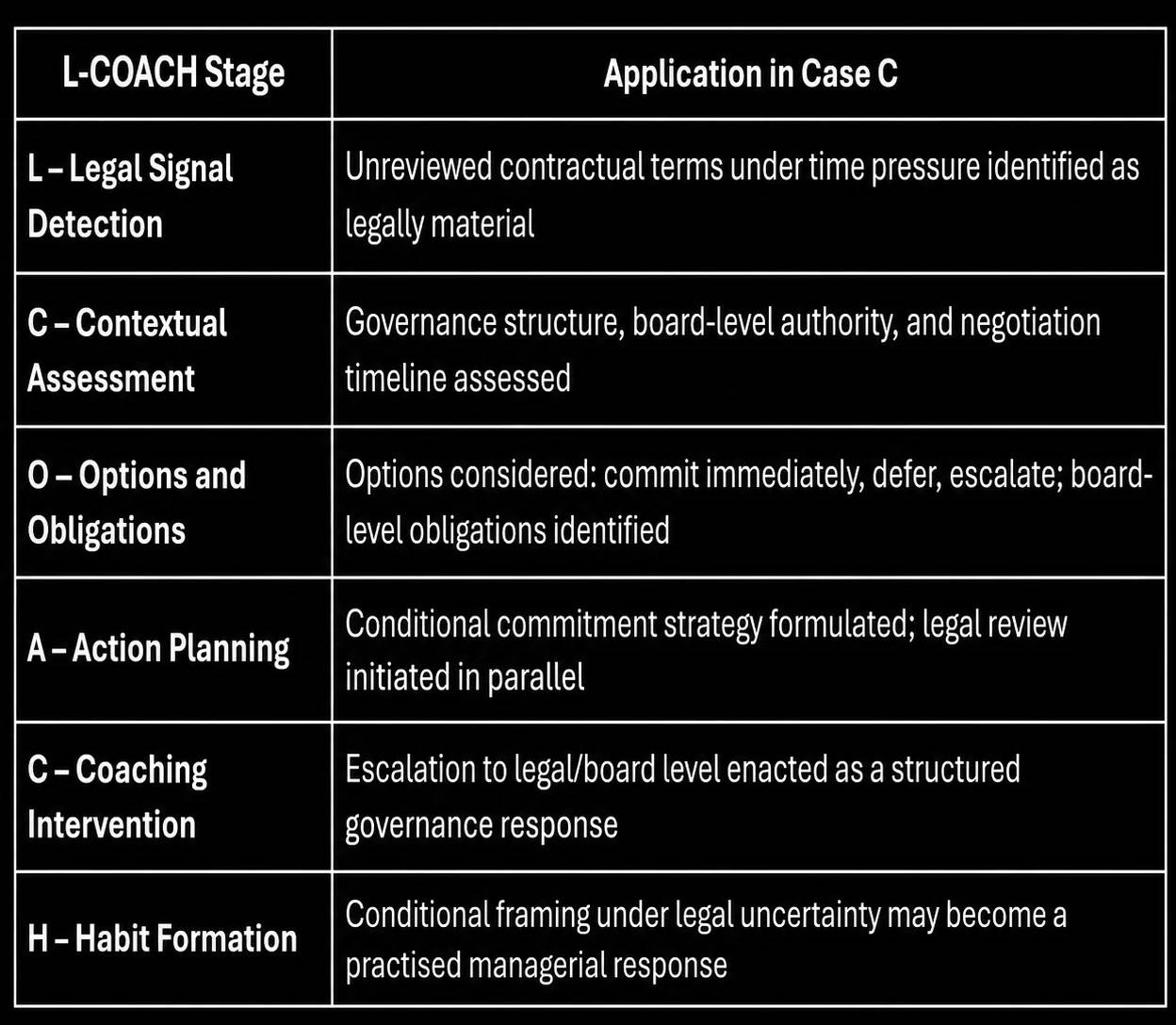
An automotive sector manager faced a contractual decision under significant time pressure during a live negotiation. The situation required an immediate commitment, yet the legal implications of the contract terms had not been fully assessed. The manager operated within a corporate governance structure in which major decisions were formally
Introducing Legal Coaching: A Framework for Legally Intelligent Decision-Making in Risk-Sensitive Organisations
defined at board level, creating tension between operational urgency and institutional protocol.
Legal Signal
Unassessed contractual terms under time pressure constituted the legal signal, with potential exposure to binding commitments made without adequate legal review.
LCF Stage Activated
Escalation Decision-Making — the manager recognised the limits of their legal knowledge and acted on that recognition by holding the decision open and initiating formal review.
L-COACH Mapping
Decision Outcome
The manager navigated the tension between time pressure and legal prudence by framing the commitment conditionally — effectively holding the decision open while initiating legal review. This outcome illustrates a core principle of the LCF: that escalation is not a failure of managerial competence, but an expression of it.
9.5 Case D — Internalised Legal Reasoning in a High-Governance Environment
Organisational Context
Introducing Legal Coaching: A Framework for Legally Intelligent Decision-Making in Risk-Sensitive Organisations
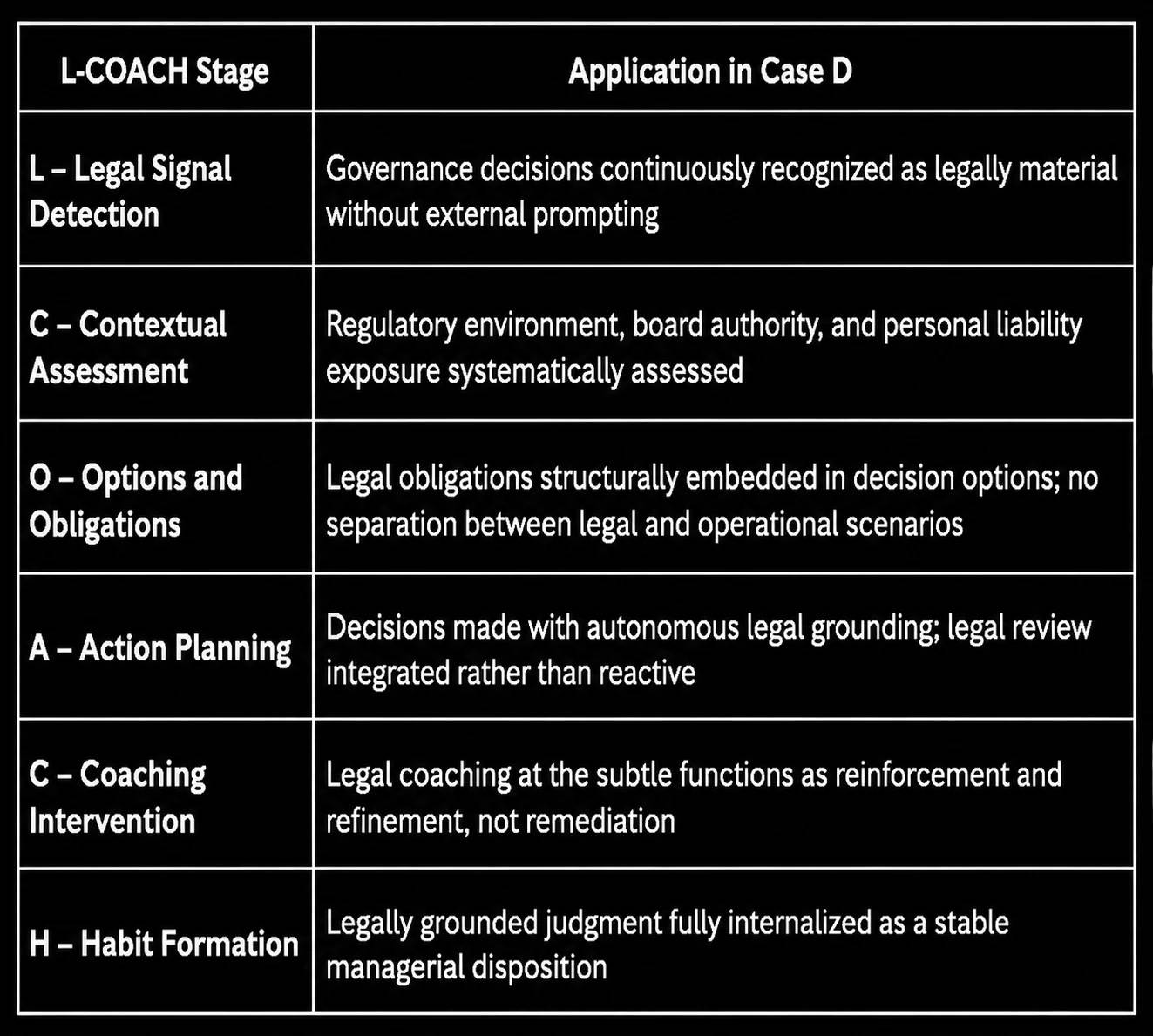
A senior manager in the mining sector operated within a complex corporate governance environment characterised by significant regulatory oversight, board-level accountability, and substantial personal liability exposure. Legal considerations were not peripheral to this manager’s decision-making — they were structurally embedded in the organisational context.
Legal Signal
Governance decisions carrying board-level authority and personal liability exposure constituted ongoing legal signals, requiring continuous and autonomous legal reasoning rather than episodic consultation.
LCF Stage Activated
Internalised Legal Reasoning — the manager demonstrated a fully developed legal intelligence, engaging with governance structures not merely as compliance requirements but as active legal logic.
L-COACH Mapping
Decision Outcome
The manager’s approach to corporate governance decisions reflected a fully developed legal intelligence. This case suggests that the endpoint of legal coaching is not dependence on legal specialists, but the development of autonomous, legally grounded judgement.
9.6 Cross-Case Analysis
Introducing Legal Coaching: A Framework for Legally Intelligent Decision-Making in Risk-Sensitive Organisations
The four cases illustrate a coherent developmental trajectory in managerial legal intelligence — one that maps onto the sequential structure of the LCF.
Table 6. Cross-Case Analysis: LCF Stages and L-COACH Application
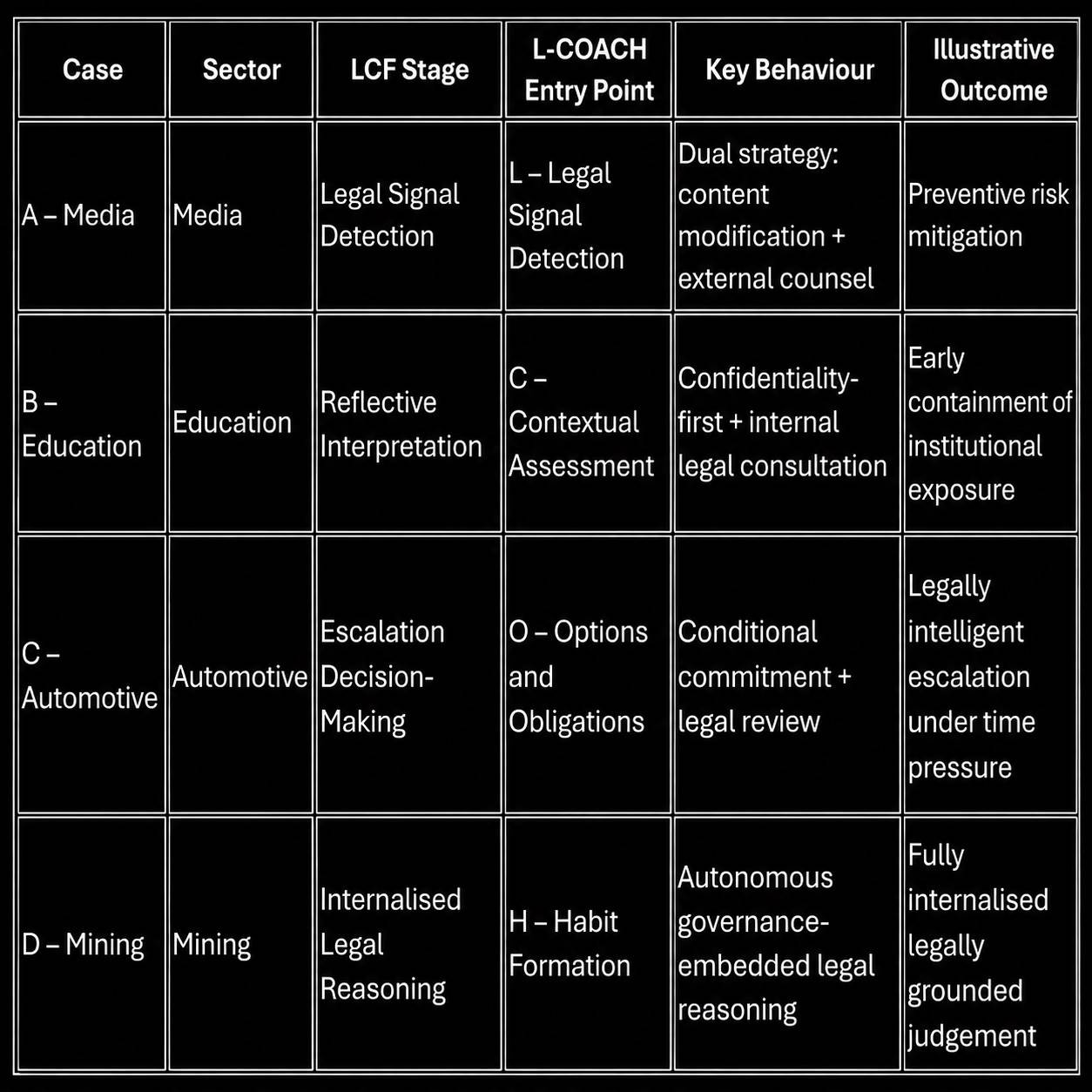
These illustrative cases are consistent with the theoretical premises of the LCF and suggest how the framework’s concepts may apply across diverse organisational and sectoral contexts.
9.7 Implications for the Legal Coaching Framework
The vignettes presented in this section reinforce the conceptual architecture of the LCF in several respects. The process described across all four cases mirrors the framework’s sequential structure — Legal Signal Detection, Reflective Interpretation, Escalation Decision-Making, and Internalised Legal Reasoning — each operationalised through the six stages of the L-COACH model.
The cases further suggest that many managers may already be navigating this process intuitively, but doing so inconsistently and without a shared conceptual vocabulary. Legal
Introducing Legal Coaching: A Framework for Legally Intelligent Decision-Making in Risk-Sensitive Organisations
coaching, as proposed here, functions as a structured intervention that renders this implicit process explicit — enabling managers to identify risk signals earlier, evaluate consequences more systematically, and arrive at more reasoned and legally informed decisions. These observations are illustrative rather than conclusive; empirical investigation would be required to assess the extent to which the framework produces these outcomes in practice.
Section 10 — Why Legal Coaching is a Distinctive Approach
Legal coaching occupies a distinct position within the broader landscape of organisational risk management. It draws on preventive law (Dauer, 2004), managerial cognition (Walsh, 1995), and coaching psychology (Grant, 2003) — a combination that sets it apart from compliance training and legal advice, as well as from adjacent approaches such as Legal Design Thinking and legal operations frameworks. The following subsections examine these distinctions in turn.
10.1 Distinguishing Legal Coaching from Compliance Training
Compliance training is a common mode of legal risk education in organisations. It is characterised by rule dissemination, prescriptive instruction, and information transfer — typically delivered through structured programmes designed to ensure regulatory adherence (Parker & Nielsen, 2011). While compliance training is well-suited to conveying what the rules are, it is less focused on developing the capacity to recognise when and how those rules become relevant in ambiguous, real-time managerial situations.
Legal coaching addresses a different cognitive challenge. Rather than transmitting legal content, it aims to develop the capacity to detect early signals of legal salience, interpret ambiguous cues, and engage in deliberate reflection before action. This maps onto the L (Legal Awareness) and C (Contextual Assessment) stages of the L-COACH model, where the primary task is not rule recall but attentional orientation and situational interpretation.
These two approaches are not mutually exclusive. Compliance training may establish the foundational legal knowledge that legal coaching then activates in context. The cognitive mechanisms they engage, however, differ: compliance training relies primarily on declarative memory and rule application, whereas legal coaching is intended to engage metacognitive monitoring, legal sensemaking, and attentional reframing (see Section 8). This distinction informs Proposition P7: that legal coaching may improve cue recognition
Introducing Legal Coaching: A Framework for Legally Intelligent Decision-Making in Risk-Sensitive Organisations
and legal sensemaking in novel or ambiguous situations beyond what compliance instruction alone provides — a claim that remains to be tested empirically.
10.2 Distinguishing Legal Coaching from Legal Advice
Legal advice is a specialist, interpretive activity delivered by qualified legal professionals, typically in response to a specific legal question or emerging dispute. It is, by nature, reactive — triggered when a legal issue has already become salient — and it operates within a professional relationship governed by duty of care, privilege, and regulatory obligation (Sherr, 1999).
Legal coaching differs in both timing and function. It is developmental and preventive, aimed at building the manager’s capacity to identify legally sensitive situations before they require specialist intervention. Legal coaching does not substitute for legal advice; rather, it may improve the quality of the interface between managers and legal counsel by supporting managers’ ability to recognise when escalation is warranted, articulate the relevant facts, and engage more productively with specialist advice when it is sought.
This distinction is reflected in the O (Options Appraisal) and A (Action Planning) stages of L- COACH, where managers are supported in evaluating response pathways — including the decision to seek legal advice — rather than being directed toward a predetermined outcome. The coaching relationship is designed to preserve managerial agency while expanding legal awareness, a combination that neither legal advice nor compliance training is intended to provide.
10.3 Legal Coaching and the “Human Firewall”
The metaphor of the “human firewall” — drawn from organisational resilience and high- reliability systems literature — describes frontline actors as a primary defence against systemic failure (Reason, 1997; Weick & Sutcliffe, 2007). In the context of legal risk, this framing positions managers not merely as rule-followers but as active agents capable of identifying and containing legal exposure before it escalates into formal liability.
It should be noted that this metaphor originates in safety-critical and cybersecurity contexts, and its application to legal risk management requires qualification. Legal risk differs from technical or physical hazard in that it is often socially constructed, interpretively ambiguous, and embedded in relational dynamics that resist algorithmic detection. The value of the metaphor lies not in technical precision but in its emphasis on human judgment as a first-order defence mechanism — a position consistent with the
Introducing Legal Coaching: A Framework for Legally Intelligent Decision-Making in Risk-Sensitive Organisations
preventive law tradition (Dauer, 2004) and with work on legal consciousness in organisations (Ewick & Silbey, 1998).
Legal coaching may support this capacity by developing the reflective and metacognitive skills that enable managers to function as frontline risk interceptors. This is reflected in the H (Habit Formation) stage of L-COACH, where repeated coaching interactions are hypothesised to consolidate legal sensitivity into more stable behavioural routines. This mechanism informs Proposition P8: that sustained legal coaching engagement may support the development of legal risk interception as a more routine managerial practice — a hypothesis that requires empirical examination.
10.4 Situating Legal Coaching Among Adjacent Approaches
Beyond compliance training and legal advice, legal coaching should also be distinguished from a broader set of approaches that share some of its features but differ in purpose, method, or scope.
Legal Design Thinking (Hagan, 2020; Masson & Shariff, 2019) applies human-centred design principles to the creation of legal products, services, and processes. It is primarily a systems-level intervention, concerned with redesigning legal interfaces to improve usability and accessibility. Legal coaching, by contrast, is an individual-level developmental intervention focused on building the cognitive and reflective capacities of specific managers. The two approaches are potentially complementary — legal design thinking may create more navigable legal environments, while legal coaching aims to develop the capacity to operate within them — but they address different units of analysis and engage different mechanisms of change.
Legal Operations frameworks (Sako, 2020) focus on the structural and technological optimisation of legal service delivery within organisations, including process management, technology adoption, and resource allocation. This is a systems-level concern, distinct from the individual cognitive development that legal coaching targets.
Restorative and therapeutic jurisprudence approaches (Wexler & Winick, 1996) share legal coaching’s interest in the psychological dimensions of legal engagement, but are primarily concerned with the wellbeing of legal subjects — such as litigants or offenders — rather than with the legal risk management capacities of organisational decision-makers.
Table 7: Legal Coaching Compared with Adjacent Approaches
Introducing Legal Coaching: A Framework for Legally Intelligent Decision-Making in Risk-Sensitive Organisations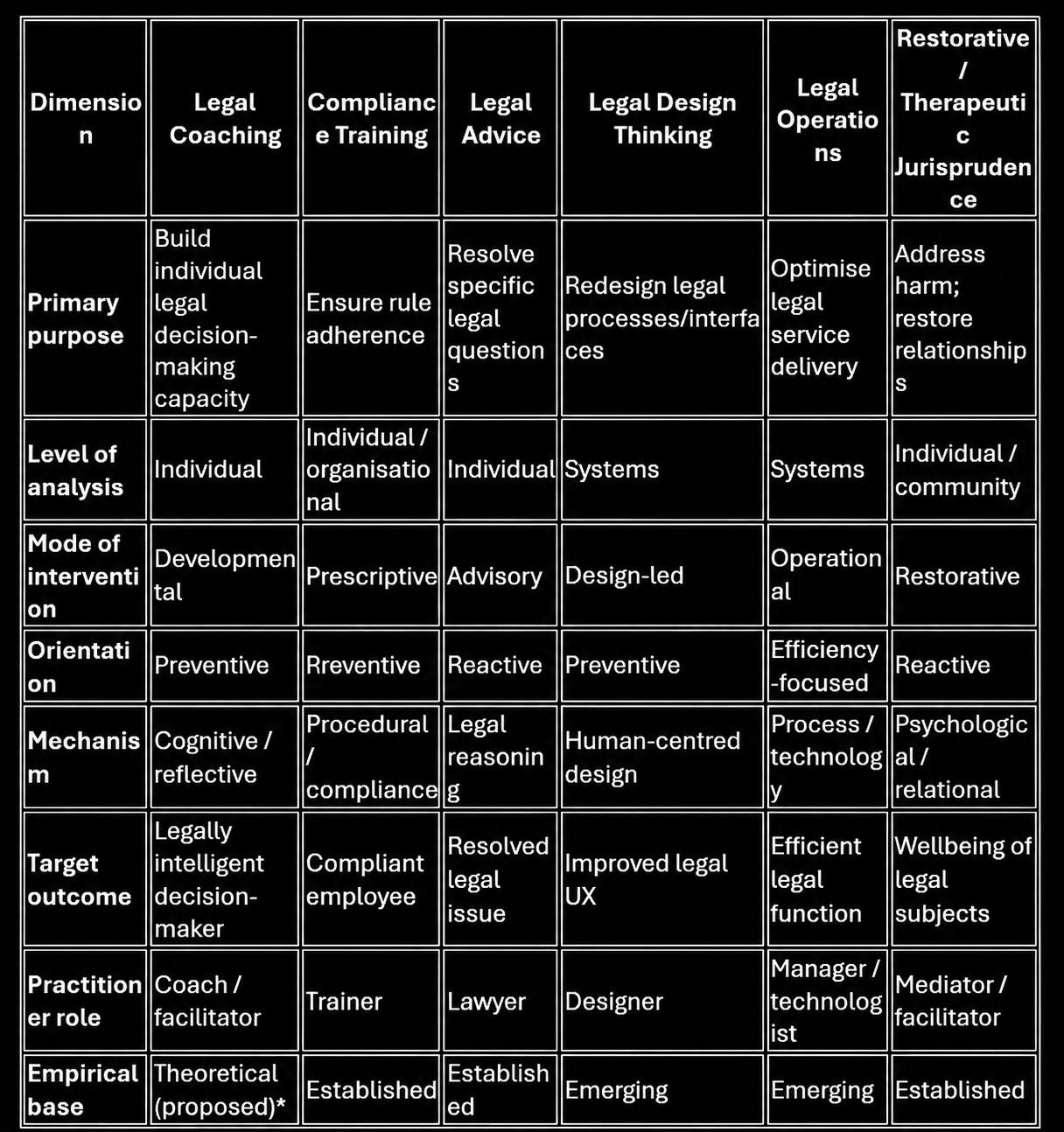
Footnote:
* “Theoretical (proposed)” indicates that Legal Coaching as defined in this framework has not yet been independently validated through empirical research. The framework is offered as a conceptual contribution and is intended to guide future empirical testing and practitioner application.
Introducing Legal Coaching: A Framework for Legally Intelligent Decision-Making in Risk-Sensitive Organisations
Taken together, legal coaching is characterised by a specific combination of features: it is preventive rather than reactive, developmental rather than prescriptive, individual-level rather than systemic, and cognitively oriented rather than procedurally focused. No single adjacent approach shares all four of these characteristics, which provides a basis for treating legal coaching as a conceptually distinct contribution to the organisational legal risk management literature — one whose practical value remains to be established through empirical research.
10.5 Ethical and Professional Boundary Considerations
The development of legal awareness in organisational settings raises a set of ethical and professional boundary questions that any framework in this domain must address explicitly. The LCF and L-COACH model are designed to enhance managerial legal sensitivity — not to expand the scope of managerial authority into territory reserved for qualified legal professionals. This distinction is not merely definitional; it carries practical and regulatory significance.
The boundary between legal coaching and legal advice. Legal coaching, as conceptualised in this framework, is a developmental intervention directed at metacognitive capacity, attentional reframing, and legal sensemaking. It does not involve the provision of legal advice, the interpretation of specific legal instruments, or the rendering of professional legal judgments. These functions remain the exclusive domain of qualified legal counsel. Organisations implementing the framework must ensure that this boundary is institutionally maintained — through clear role definitions, governance protocols, and explicit escalation pathways.
Unauthorised practice of law. A structurally important risk in any programme that develops legal awareness among non-lawyers is the inadvertent encouragement of quasi- legal decision-making that bypasses professional oversight. The L-COACH model addresses this risk by design: its developmental logic culminates not in managerial legal autonomy, but in what Stage 5 describes as legally intelligent judgment — the capacity to recognise when a matter requires professional legal input and to engage counsel effectively. Legal intelligence, in this framework, includes knowing the limits of one’s own competence.
Duty of care and confidentiality. Where legal coaching is delivered by in-house counsel or external legal professionals, questions of professional duty of care, legal professional privilege, and confidentiality of communications may arise. Organisations should seek appropriate legal and professional guidance on the governance of coaching relationships that involve legally sensitive information. The framework does not resolve these questions, but it flags them as necessary considerations in implementation design.
Introducing Legal Coaching: A Framework for Legally Intelligent Decision-Making in Risk-Sensitive Organisations
Escalation as a competency. The framework explicitly treats timely escalation to qualified legal counsel as a marker of legal intelligence rather than a failure of managerial competence. Organisations implementing L-COACH should embed escalation protocols as a formal component of the coaching programme, ensuring that managers are trained not only to recognise legal risk but to respond to it through appropriate institutional channels.
These considerations do not constrain the framework’s applicability; they define the conditions under which it can be applied responsibly. Future empirical work should examine how organisations operationalise these boundaries in practice, and whether formal governance structures moderate the effectiveness of legal coaching interventions.
11. Research Contributions, Limitations, and Future Directions
This study advances the conceptualisation of legal coaching, situating it at the intersection of organisational law, managerial behaviour, and coaching psychology. While traditional legal risk management focuses on normative rule-dissemination or reactive specialist consultation (Parker & Nielsen, 2011), this research argues that the critical component lies in how managers allocate cognitive resources to legal dimensions during decision-making (Walsh, 1995). The contributions of this study are both theoretical and practical; however, they remain exploratory in nature, and the limitations identified here simultaneously delineate promising avenues for future empirical inquiry.
11.1 Theoretical Contributions
The primary theoretical contribution is the formalisation of a conceptual framework for the emergence of internalised legal reasoning among managers. By integrating cognitive mechanisms — specifically metacognition (Flavell, 1979), legal sensemaking (Weick, 1995), attentional reframing (Higgins, 2000), and bias reduction (Kahneman, 2011) — the Legal Coaching Framework (LCF) bridges the gap between legal consciousness (Ewick & Silbey, 1998) and managerial discretion (Hambrick & Finkelstein, 1987). This contribution moves beyond static compliance models by positioning legal sensitivity as a dynamic, cognitive capacity that evolves through reflective intervention.
The proposition set developed across this manuscript (P1–P8) provides a theoretically grounded and empirically testable architecture for this claim. Collectively, these propositions map the developmental trajectory from initial cue recognition (P1, P3, P7) through metacognitive reflection and bias reduction (P2, P5, P6) to the internalisation of
Introducing Legal Coaching: A Framework for Legally Intelligent Decision-Making in Risk-Sensitive Organisations
legal reasoning as a durable managerial disposition (P4) and its expression as proactive organisational risk interception (P8). This proposition chain represents a contribution to both coaching psychology and the emerging literature on legally intelligent organisations.
11.2 Practical and Managerial Contributions
Practically, the L-COACH operational model translates the abstract theoretical architecture of the LCF into a structured, six-stage developmental intervention. This model provides an actionable tool for executive education and organisational governance, directly addressing the “knowing-doing gap” in corporate compliance (Pfeffer & Sutton, 2000). Each stage of L-COACH — from L (Legal Signal Detection) through to H (Handover or Hold) — corresponds to a specific cognitive mechanism and a testable proposition, ensuring that the model is both theoretically coherent and practically deployable.
Furthermore, legal coaching may enhance legal risk literacy among executives — a critical competence for navigating complex, high-ambiguity organisational environments (Edelman, 2016). By fostering this literacy through repeated structured engagement, the model may enable the institutionalisation of a human firewall (Reason, 1997), where professional awareness functions as a proactive, non-prescriptive barrier to organisational crises. This practical contribution is most directly captured in P8, which holds that managers with repeated legal coaching experience are more likely to intercept legally significant risk signals prior to formal escalation.
11.3 Limitations
This research is primarily conceptual and qualitative in nature, and its findings should be interpreted accordingly. The LCF and L-COACH model are presented as theoretically grounded frameworks rather than empirically validated instruments. Several specific limitations warrant acknowledgement.
First, the absence of empirical validation means that the causal claims embedded in the proposition set (P1–P8) remain theoretical. The relationships proposed between structured legal coaching, metacognitive development, and legal risk outcomes have not yet been tested against observational or experimental data. Future studies should employ quantitative and survey-based methodologies to validate the L-COACH model across diverse organisational contexts (Creswell & Plano Clark, 2017).
Second, this study prioritises the elucidation of cognitive processes over the measurement of objective organisational outcomes. Future research should investigate the efficacy of legal coaching using longitudinal or quasi-experimental designs, focusing on measurable
Introducing Legal Coaching: A Framework for Legally Intelligent Decision-Making in Risk-Sensitive Organisations
indicators such as reduction in legal claims, mitigation of litigation costs, or improvements in early escalation rates . Such studies would provide the empirical grounding necessary to assess operational impact and to test the proposition chain systematically.
Third, the framework has been developed primarily within a Western, common-law organisational context. Its applicability across different legal systems, cultural environments, and organisational structures remains an open question that comparative and cross-jurisdictional research should address.
11.3.1 Boundary Conditions of the Framework
The preceding limitations point to a set of boundary conditions that define the scope within which the LCF and L-COACH model are expected to operate most effectively. Identifying these conditions is not merely a concession to the framework’s current developmental stage; it is a theoretically necessary step in specifying the domain of applicability of any conceptual model (Whetten, 1989; Bacharach, 1989).
Organisational context. The framework is designed primarily for mid-to-large organisations operating in risk-sensitive sectors — including financial services, healthcare, energy, and professional services — where legal exposure is structurally embedded in managerial decision-making. In smaller organisations or those with minimal regulatory exposure, the cost-benefit calculus of sustained legal coaching may differ substantially, and the developmental arc described in L-COACH may compress or manifest differently.
Legal system. The framework’s underlying assumptions — including the centrality of precedent-based reasoning, the adversarial framing of legal risk, and the role of in-house counsel as a strategic partner — reflect a common-law institutional environment. In civil- law jurisdictions, where codified rules and inquisitorial processes predominate, the cognitive demands placed on managers may differ in kind rather than degree. The metacognitive reframing central to Stages 4–5 of L-COACH may require adaptation to reflect the interpretive conventions of civil-law reasoning.
Managerial level and role. The model is most directly applicable to managers with decision-making authority over legally consequential matters — contract approval, regulatory compliance, employment decisions, and risk governance. It is not designed as a general legal literacy programme for all employees, nor as a substitute for specialist legal training at the professional level.
Cultural and institutional environment. The framework assumes a baseline institutional trust in legal processes and a cultural disposition toward rule-following as a legitimate organisational norm. In environments where legal institutions are perceived as unreliable, corrupt, or instrumentally manipulated, the motivational foundations of legal internalisation (P1–P3) may require significant contextual modification.
Introducing Legal Coaching: A Framework for Legally Intelligent Decision-Making in Risk-Sensitive Organisations
These boundary conditions do not diminish the framework’s theoretical contribution; rather, they sharpen its claims by specifying where those claims are most likely to hold. Future research should treat these conditions as moderating variables in empirical designs, rather than as background assumptions.
11.4 Future Research Directions
Several directions for future inquiry emerge directly from the limitations identified above and from the theoretical architecture developed in this study.
The most immediate priority is the empirical testing of the proposition set. P1 through P8 collectively constitute a research agenda: each proposition is falsifiable and operationalisable, and together they map a developmental trajectory that longitudinal studies could trace across coaching engagements. Researchers may consider using validated instruments for metacognitive awareness (e.g., the Metacognitive Awareness Inventory; Schraw & Dennison, 1994) alongside organisational risk metrics to assess the model’s predictive validity.
A second direction concerns the role of emerging technologies — particularly AI-driven tools — in supporting managerial metacognition and legal signal detection. Such technologies could potentially serve as cognitive assistants, bolstering legal sensitivity in real-time decision-making contexts (Daugherty & Wilson, 2018), and may offer scalable complements to one-to-one coaching engagements.
Third, comparative studies between legal coaching and adjacent modalities — including legal mentoring, risk management consulting, and advanced compliance programmes — would help delineate conceptual boundaries and identify the relative advantages of each approach. The comparative framework introduced in Table 3 provides a preliminary basis for such analysis, but empirical comparison remains necessary.
Finally, future research might examine how legal coaching interacts with organisational culture, governance structures, and sector-specific regulatory environments. The human firewall metaphor (P8) implies that individual-level development must be supported by organisational conditions that reward early risk detection; understanding those conditions is a critical next step.
11.5 Concluding Remarks
Legal coaching represents a theoretically coherent and practically promising approach to the development of legally intelligent managers. By moving beyond rule-compliance
Introducing Legal Coaching: A Framework for Legally Intelligent Decision-Making in Risk-Sensitive Organisations
toward the cultivation of reflective, metacognitively aware decision-making, it addresses a gap that neither compliance training nor legal advice is designed to fill. The LCF and L- COACH model together provide both the conceptual grounding and the operational structure necessary to advance legal coaching as a preventive strategy within high-stakes organisational environments. The proposition set developed here sets a clear trajectory for future empirical research, and the limitations acknowledged above define the boundaries within which these contributions should be understood. Section 12: Summary of Theoretical Propositions
The eight propositions advanced in this paper constitute an integrated theoretical architecture that maps the developmental trajectory of legally intelligent managerial decision-making. Table 2 presents these propositions in consolidated form, organised according to their primary theoretical function within the Legal Coaching Framework.
Table 8: Summary of Theoretical Propositions (P1–P8)
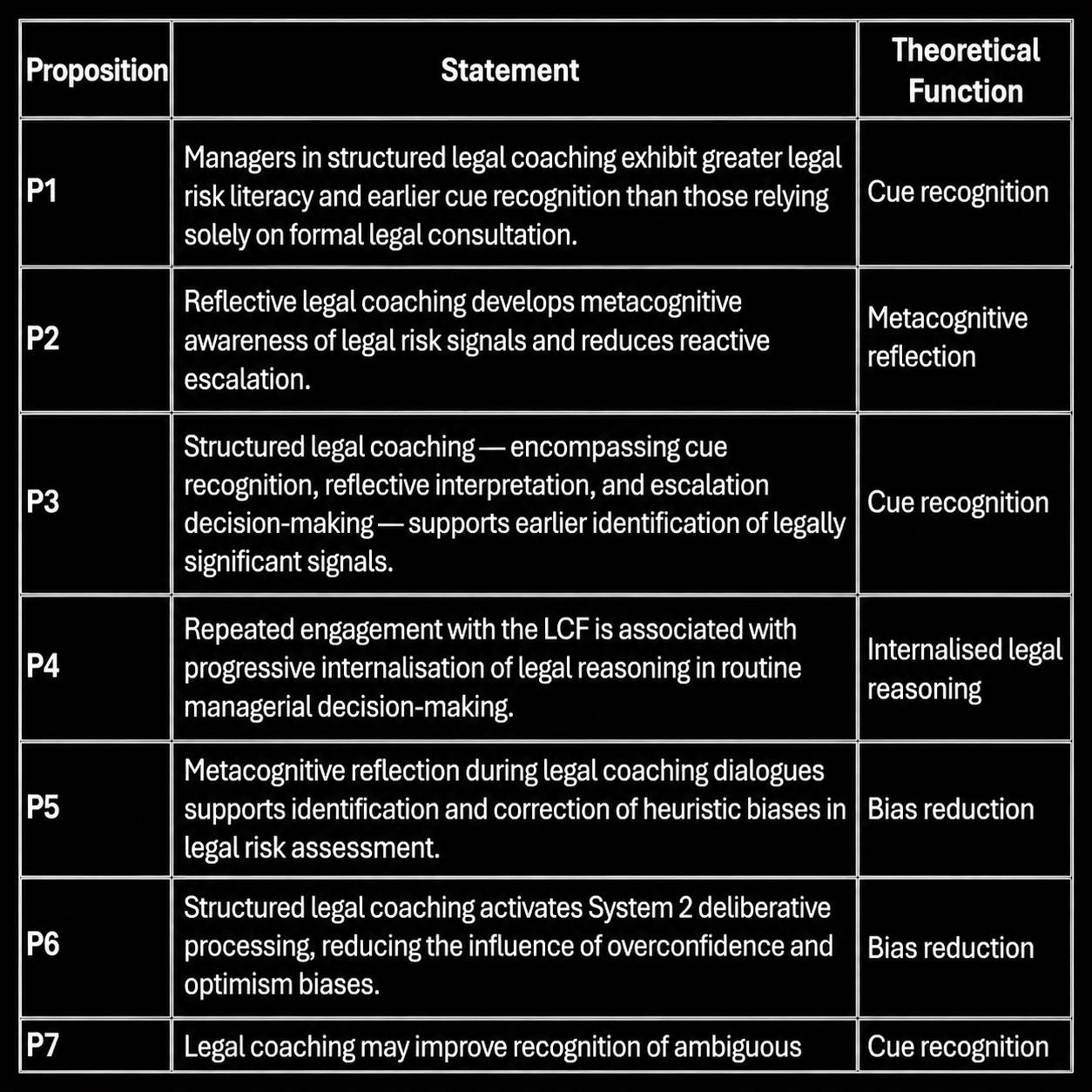 Introducing Legal Coaching: A Framework for Legally Intelligent Decision-Making in Risk-Sensitive Organisations
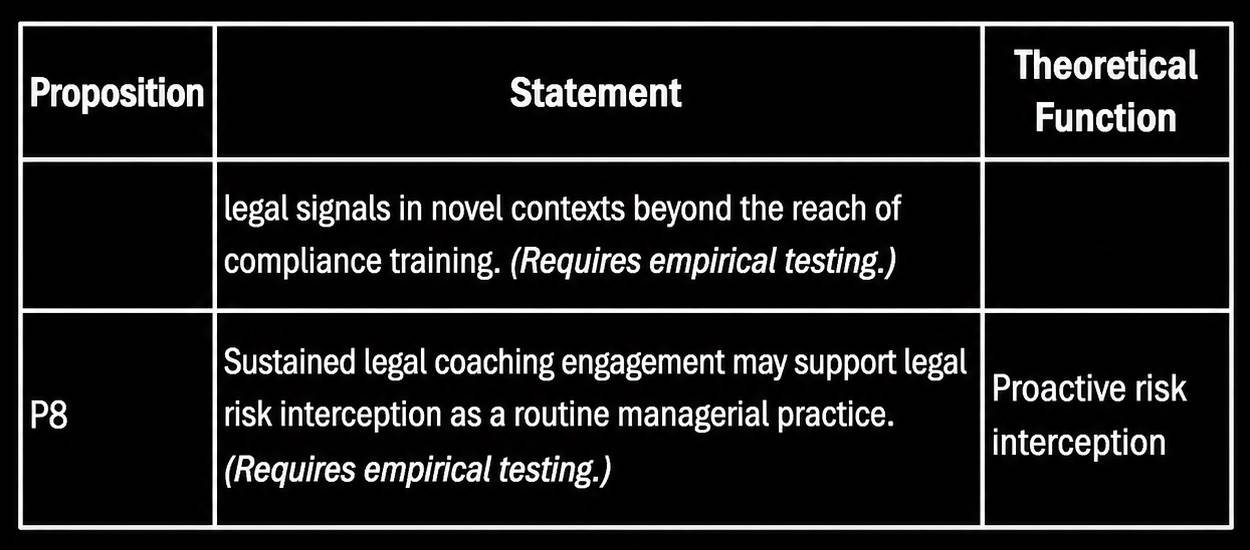 Taken together, these propositions map a developmental progression across four theoretical domains: legal cue recognition (P1, P3, P7); metacognitive reflection and bias reduction (P2, P5, P6); internalised legal reasoning (P4); and proactive organisational risk interception (P8). The central argument underlying this architecture is that many organisational legal risks arise not from a deficit of technical legal knowledge, but from systemic inattention to legal signals at critical managerial decision points. Empirical validation of the LCF and L-COACH model remains the essential next step in establishing the evidential basis for this framework.
13- Conclusion
This manuscript has advanced a conceptual framework for legal coaching as a structured developmental intervention within risk-sensitive organisations. The Legal Coaching Framework (LCF) and its operational counterpart, the L-COACH model, are offered as theoretically grounded contributions to an emerging intersection of organisational law, managerial behaviour, and coaching psychology. The contributions remain exploratory in nature, and the claims advanced here are theoretical rather than empirical.
The primary theoretical contribution lies in the formalisation of a framework for the emergence of internalised legal reasoning among managers. By integrating metacognition, legal sensemaking, attentional reframing, and bias reduction, the LCF bridges legal consciousness and managerial discretion in ways that static compliance models have not addressed. Legal sensitivity is treated not as a fixed knowledge state but as a dynamic cognitive capacity that may be developed through structured reflective practice.
The proposition set developed across this manuscript — P1 through P8 — provides a theoretically grounded and internally consistent architecture for future empirical investigation. The propositions map a developmental trajectory from initial cue recognition (P1, P3, P7), through metacognitive reflection and bias reduction (P2, P5, P6), toward the internalisation of legal reasoning (P4) and proactive organisational risk interception (P8). These relationships have not been tested; they are offered as falsifiable claims that future research may examine.
Introducing Legal Coaching: A Framework for Legally Intelligent Decision-Making in Risk-Sensitive Organisations
At the individual level, the L-COACH model may support the development of legally informed managerial judgment by providing a structured sequence through which legal risk literacy is built incrementally. At the organisational level, sustained engagement with the LCF may contribute to governance conditions in which legally sensitive decision-making becomes more consistent and proactive. It bears emphasis that legal coaching, as conceptualised here, is a developmental intervention — not a substitute for legal advice. The capacity to recognise when escalation to qualified legal counsel is required is itself treated as a core competency within the model.
The framework has been developed primarily within Western, common-law organisational contexts, and its cross-jurisdictional applicability remains an open question. Future research should subject the proposition chain to empirical scrutiny through quantitative, longitudinal, and quasi-experimental designs, and should examine outcomes including early escalation rates, litigation cost reduction, and the operationalisation of boundary conditions across different legal systems and organisational structures. Empirical validation of the LCF and L-COACH model remains the critical next step. 14. AI Use Disclosure
During the preparation of this manuscript, Claude (Anthropic) was used to assist with translation and language refinement of original Persian-language drafts into English. Gemini (Google) was used to support the design and generation of infographic-style visual materials. As a Persian-speaking researcher, the author employed these tools to ensure linguistic accuracy and visual clarity. All AI-assisted outputs were reviewed, edited, and verified by the author, who takes full responsibility for the content, interpretation, and accuracy of the manuscript.
References
1. Ansoff, H. I. (1975). Managing strategic surprise by response to weak signals. California Management Review, 18(2), 21–33. 2. Argyres, N., & Mayer, K. J. (2007). Contract design as a firm capability. Academy of Management Review, 32(4), 1060–1077. 3. Argyris, C. (1991). Teaching smart people how to learn. Harvard Business Review, 69(3), 99–109. 4. Austin, J. L. (1962). How to do things with words. Oxford University Press. 5. Barnard, C. I. (1938). The functions of the executive. Harvard University Press. 6. Bazerman, M. H., & Moore, D. A. (2013). Judgment in managerial decision making. John Wiley & Sons. 7. Brown, L. M., & Dauer, E. A. (1994). Planning by lawyers. Foundation Press. 8. Brown, M. E., & Treviño, L. K. (2006). Ethical leadership. The Leadership Quarterly, 17(6), 595–616.
Introducing Legal Coaching: A Framework for Legally Intelligent Decision-Making in Risk-Sensitive Organisations
9. Chabris, C., & Simons, D. (2010). The invisible gorilla. Crown Publishing. 10. Cowan, D. (2004). Legal consciousness: Some observations. Modern Law Review, 67(6), 928–958. 11. Creswell, J. W., & Plano Clark, V. L. (2017). Designing and conducting mixed methods research. Sage Publications. 12. Daugherty, P. R., & Wilson, H. J. (2018). Human + machine. Harvard Business Press. 13. Boyce, L. B. (2005). Rivers of law and sites of contestation. Law & Social Inquiry, 30(1), 181–194. 14. Edelman, L. B. (2016). Working law. University of Chicago Press. 15. Edelman, L. B., & Suchman, M. C. (1997). The legal environments of organizations. Annual Review of Sociology, 23, 479–515. 16. Eisenhardt, K. M. (1989). Agency theory. Academy of Management Review, 14(1), 57–74. 17. Endsley, M. R. (1995). Toward a theory of situation awareness. Human Factors, 37(1), 32–64. 18. Ewick, P., & Silbey, S. S. (1998). The common place of law. University of Chicago Press. 19. Flavell, J. H. (1979). Metacognition and cognitive monitoring. American Psychologist, 34(10), 906–911. 20. Flin, R., O’Connor, P., & Crichton, M. (2008). Safety at the sharp end. Ashgate Publishing. 21. Grant, A. M. (2012). An examination of coaching as a leadership development tool. International Coaching Psychology Review, 7(1), 47–60. 22. Greenwood, R., Oliver, C., Lawrence, T. B., & Meyer, R. E. (2017). The SAGE handbook of organizational institutionalism. Sage. 23. Hambrick, D. C., & Finkelstein, S. (1987). Managerial discretion. Research in Organizational Behavior, 9, 369–406. 24. Higgins, E. T. (2000). Making a good decision: Value from fit. American Psychologist, 55(11), 1217–1230. 25. Jones, R. J., Woods, S. A., & Guillaume, Y. R. (2016). The effectiveness of workplace coaching. Journal of Occupational and Organizational Psychology, 89(2), 249–277. 26. Kahneman, D. (2011). Thinking, fast and slow. Farrar, Straus and Giroux. 27. Kahneman, D., & Tversky, A. (1979). Prospect theory. Econometrica, 47(2), 263–291. 28. Maitlis, S., & Christianson, M. (2014). Sensemaking in organizations. Academy of Management Annals, 8(1), 57–125. 29. McKergow, M., & Jackson, P. Z. (2011). The solutions focus. Nicholas Brealey. 30. Mintzberg, H. (1973). The nature of managerial work. Harper & Row. 31. Mnookin, R. H., & Kornhauser, L. (1979). Bargaining in the shadow of the law. Yale Law Journal, 88(5), 950–997. 32. Nelson, T. O. (1996). Consciousness and metacognition. American Psychologist, 51(2), 102–116. 33. Nielsen, L. B. (2000). Situating legal consciousness. Law & Society Review, 34(4), 1055–1090. 34. Parker, C. (2002). The open corporation. Cambridge University Press.
Introducing Legal Coaching: A Framework for Legally Intelligent Decision-Making in Risk-Sensitive Organisations
35. Parker, C., & Nielsen, V. L. (2011). Explaining compliance. Edward Elgar Publishing. 36. Passmore, J. (2015). Excellence in coaching. Kogan Page. 37. Passmore, J. (2021). The science of coaching. Wiley. 38. Passmore, J., & Fillery-Travis, A. (2011). A critical review of executive coaching research. International Coaching Psychology Review, 6(1), 70–86. 39. Pfeffer, J., & Sutton, R. I. (2000). The knowing-doing gap. Harvard Business School Press. 40. Reason, J. (1997). Managing the risks of organizational accidents. Ashgate. 41. Reason, J. (2000). Human error: Models and management. BMJ, 320(7237), 768– 770. 42. Schön, D. A. (1983). The reflective practitioner. Basic Books. 43. Scott, W. R. (2008). Institutions and organizations. Sage. 44. Searle, J. R. (1969). Speech acts. Cambridge University Press. 45. Searle, J. R., & Vanderveken, D. (1985). Foundations of illocutionary logic. Cambridge University Press. 46. Simon, H. A. (1977). The new science of management decision. Prentice Hall. 47. Sitkin, S. B., & Bies, R. J. (1994). Social accounts in conflict situations. Human Relations, 46(3), 349–370. 48. Sitkin, S. B., & Pablo, A. L. (1992). Reconceptualizing the determinants of risk behavior. Academy of Management Review, 17(1), 9–38. 49. Theeboom, T., Beersma, B., & van Vianen, A. E. M. (2014). Does coaching work? Journal of Positive Psychology, 9(1), 1–18. 50. Tyler, T. R. (2006). Why people obey the law. Princeton University Press. 51. Walsh, J. P. (1995). Managerial and organizational cognition. Organization Science, 6(3), 280–321. 52. Weick, K. E. (1995). Sensemaking in organizations. Sage Publications. 53. Weick, K. E., & Sutcliffe, K. M. (2007). Managing the unexpected (2nd ed.). Jossey- Bass. 54. Weick, K. E., Sutcliffe, K. M., & Obstfeld, D. (2005). Organizing and the process of sensemaking. Organization Science, 16(4), 409–421.




دیدگاهتان را بنویسید